
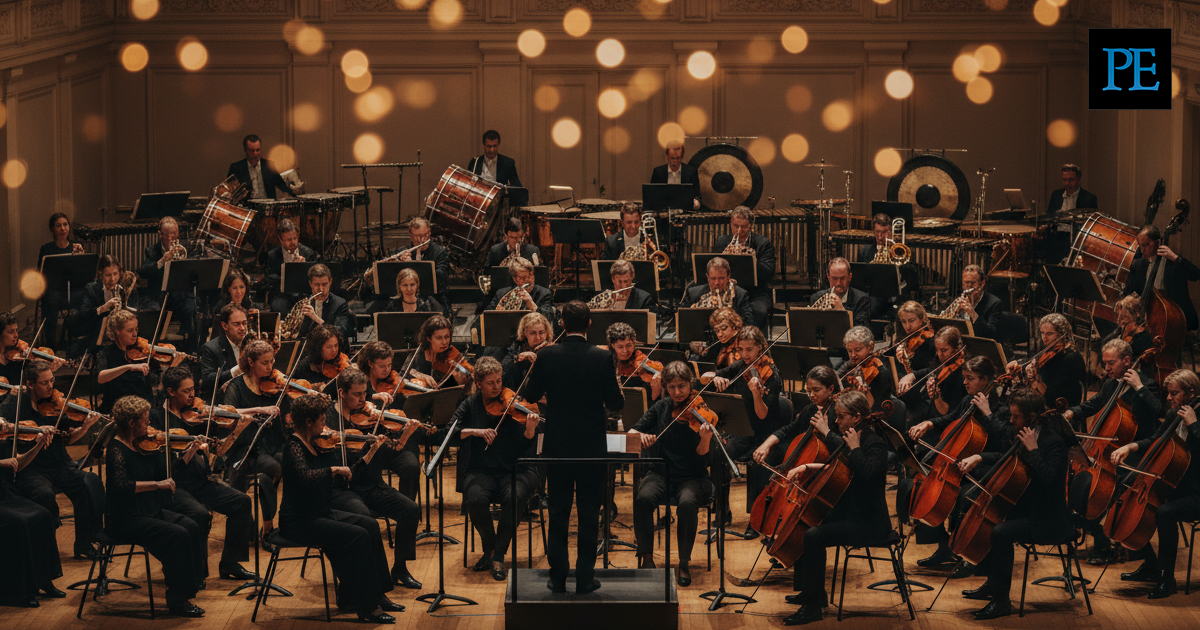
Symphony No.5 ('Childhood') marks somewhat of an evolution in Ritchie's writing, as he further embraces the minimalist techniques that have influenced his previous work. As its title suggests, the conceptual wellspring for this symphony is childhood. Hence, a newfound lightness is audible in Symphony No.5, complemented by pure, clear instrumental timbres, though the loss of innocence from the trials of adulthood lingers nearby. Beautiful, expressive solo passages emerge, particularly for oboe, while elsewhere the orchestra becomes swirling and thunderous as if mimicking the chaotic action of a packed playground, creating an affecting portrait of this magical first stage of life.
Symphony No.5 was composed during 2016-2018, which included a residency at Sweden's Visby International Composers Centre in October 2016. It was written for the Christchurch Symphony Orchestra to celebrate the re-opening of the Christchurch Town Hall.
Some of my most formative and positive musical experiences occurred in the Christchurch Town Hall, an iconic building designed by Warren and Mahoney and opened in 1972. As a 12-year-old I watched my father conduct Beethoven's 5th Symphony at the Hall's inaugural concert, and I regularly attended Christchurch Symphony Orchestra and New Zealand Symphony Orchestra concerts at the Hall throughout my teens, developing a love of orchestral music. The Hall was threatened with demolition following the destructive Canterbury earthquakes of 2010 and 2011; when the decision was made to restore it I decided to write a new symphony in dedication to both the Hall and the restoration of a city. This followed on from my fourth symphony, which had reflected on the tragedy of the quakes themselves.
In recent years I have explored themes of childhood and simplicity, in works such as Childhood for piano trio, Spirals for two violins and viola, and Picture Stones for clarinet, violin, and piano. I have become interested in the idea of creating what I label as naïve music: music that creates the illusion of being childlike and unsophisticated on the surface but carries deeper layers of perception and meaning beneath. The initial catalysts for this idea were the so-called Naïve artists such as Rosseau and Pirosmani, and the art of traditional cultures. This approach has been coupled with my own musical aesthetic, which has moved away from modernist methods towards a postmodernist approach that encompasses minimalism, the referencing of traditional musics, and environmental sound (for example, Indonesian gamelan, East European fiddle music, Maori taonga puoro, birdsong). A third impetus for a naïve style comes from my research into the effect of music on the brain. I have been interested in how music can reach ancient, primal parts of our brain, including parts not associated with speech. There is a large body of writing on emotion in music that supports this; for example, Leonard Meyer's Emotion and Meaning in Music. I am interested in the impact music has on children, and the power it has to create primal emotions in older listeners that tap into childhood memories. Symphony No.5 represents both a looking back at the past and a moving forward in a new direction, as symbolized by references to childhood and, simultaneously, reflections on adulthood. Childhood is used as a metaphor for renewed hope and optimism for the future but is also challenged by adult realities. We take our childhood with us through life.