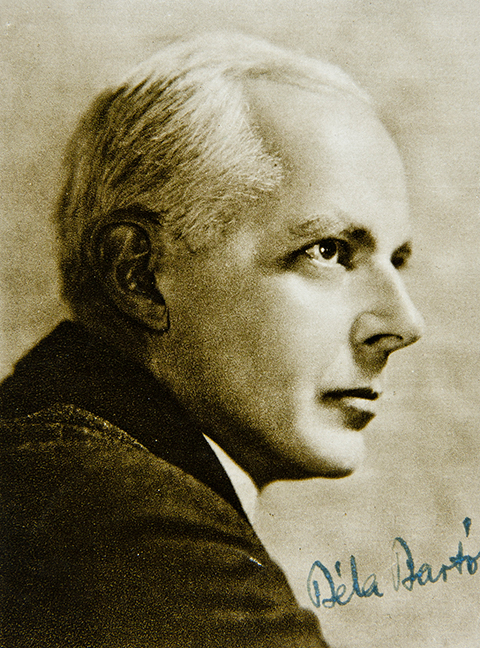
Béla Bartók (1881-1945) is considered one of the most important composers of the 20th century. Though his early works displayed the influence of nationalism and late Romantic figures such as Brahms and Strauss, the creative path that defined Bartók’s career was his incorporation of elements of folk music. As his interest in folk music grew, its distinctive modes and irregular rhythms became a hallmark of Bartók’s compositions, be they small piano pieces or masterfully orchestrated symphonies. Bartók’s extensive collection and analytical study of folk music made him a pioneer in the field of study that would later come to be known as ethnomusicology.
Bartók was born in the Banatian town of Nagyszentmiklós in the Kingdom of Hungary (present-day Sânnicolau Mare, Romania) on 25 March 1881. He displayed significant musical talent from a very early age and began receiving lessons from his mother at the age of five. Following the sudden death of his father in 1888, Bartók’s mother moved the family out of Nagyszentmiklós, living in various towns before settling in Pressburg (Pozsony, present-day Bratislava, Slovakia) in 1894. Bartók attended Pressburg’s Gymnasium, where he studied piano with László Erkel and Anton Hyrtl, and composed sonatas and quartets. Fellow Hungarian composer, pianist and conductor Ernö von Dohnányi was a senior pupil at the Gymnasium, and it was Dohnányi’s influence that led Bartók to attend the Royal National Hungarian Academy of Music in Budapest (1899-1903), where he studied piano under Franz Liszt’s pupil István Thomán, and composition under János Koessler. It was at the Academy that Bartók met Hungarian composer Zoltán Kodály; the two of them would become lifelong friends, with Bartók often turning to Kodály for advice.
Strauss was the strongest of Bartók’s early influences, as evidenced in his nationalistic symphonic poem Kossuth (1903). His nationalistic approach evolved when he became interested in folk music, sparked by his overhearing a young Transylvanian nanny singing folk songs to the children in her care at a Hungarian resort in 1904. Bartók and Kodály shared the belief that Hungarian nationalism had reached a creative dead-end, with the only solution being the creation of works based on folk music. Bartók transcribed and recorded the folk and peasant melodies of Magyar, Slovak and Romanian language territories as part of his early field research. Over the next few years, Bartók's orchestral works still recalled the style of Strauss and Brahms, but a number of short piano pieces displayed his growing interest in folk music. His String Quartet No.1 in A minor (1908) is the work that announced the arrival of his new voice, fully embracing folk music styles. In 1907 Bartók became a piano professor at the Royal National Hungarian Academy of Music, which freed him from touring Europe as a pianist and allowed him to settle in Hungary and continue his folksong research.
The outbreak of World War I put Bartók’s field research on hold. This led to a renewed focus on composing, which yielded Debussy-influenced works such as the ballet The Wooden Prince (1914-16) and String Quartet No.2 (1915-17). Bartók's libretto for his pantomime ballet The Miraculous Mandarin (1918) revealed the influence of Stravinsky and Schoenberg, as did his pair of harmonically and structurally complex violin sonatas (1921, 1922). Bartók’s international reputation was truly established with the success of his buoyant Dance Suite for orchestra (1923). Bartók’s unique voice became increasingly clear in his later years; though this period consists of relatively few works, most of them are large-scale compositions for large settings.
In 1940 Bartók and his second wife left war-torn Europe for New York, where he was made an honorary doctor at Columbia University. In contrast to Bartók’s feelings of alienation in his new home, he wrote the exuberant Concerto for Orchestra in 1943 after a commission from conductor Sergei Koussevitzky for the Boston Symphony Orchestra. His complex Sonata for solo violin (1944) followed, with his Piano Concerto No.3 nearing completion when he died from complications of leukemia on 26 September 1945. His Viola Concerto (PE065), commissioned by Scottish violist William Primrose, was left in sketch form but has since been critically restored by Bartók scholar Csaba Erdélyi. In 1988 Bartók’s remains were exhumed and transferred back to Hungary, where he was given a state funeral and re-interred at Budapest's Farkasréti Cemetery.
Among Bartók's most important works are his six string quartets, which extended the musical and technical scope of the form, his Music for Strings, Percussion and Celesta (1936), and his Concerto for Orchestra (1943). His mastery of the piano is evident in the unique writing found in his three piano concertos, and he contributed a fantastic resource for beginner pianists with Mikrokosmos, his six-volume collection of graded piano pieces.
Photo credit: See page for author, Public domain, via Wikimedia Commons
Our published editions have been edited and engraved in accordance with Promethean Editions’ exacting house style, with full biographical details of the composer, programme notes and performance instructions. Performance Scores have been designed to perform from; Performance Sets include a score and performance material; and Performance Parts only incude the performance material.
Works are also included in our ever popular series for younger performers.