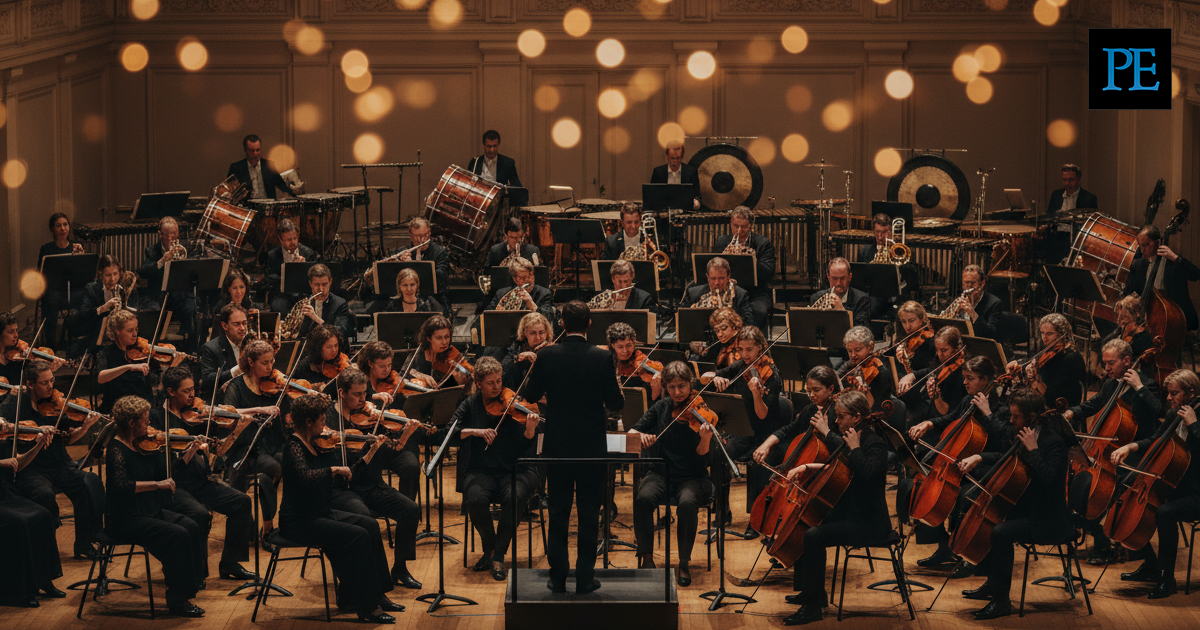
Symphony No.2 is a fine example of Ritchie's ability to take a surprisingly small amount of thematic material and draw it out into a highly compelling long-form narrative. Across its half-hour duration, Ritchie uses versatile themes and motifs to convey a shifting proximity to something dangerous or precarious - be it an external danger or something within, inherent in human nature. Textures thicken and quickly dissipate, as if a dream, with this constant wave-like fluctuation also acting upon dynamics and chromatic motivic contours. Much of Symphony No.2 is propelled by insistent quaver and semiquaver rhythms, which are organised into jagged patterns with the onset of the second movement, with each section of the orchestra engaging in some syncopated rhythmic interplay. Elsewhere, thunderous percussion and powerful brass evoke conflict, with xylophone, marimba, electronic keyboard and poi adding timbral interest to the symphony's arc. A more optimistic tone is introduced with the third movement; an industrious busyness and bustle evoking human progress. Ritchie's fluency with counterpoint is demonstrated in this movement's tightly twisting canonic lines, infused with metaphorical meaning. It is often these extra-musical concepts that underpin the symphony's structures, yet Ritchie navigates his weighty allusions with a balanced hand, providing a compelling structural and emotional arc.
When asked to compose a work on the meaning and symbolism of the new millennium I decided to use William Butler Yeats' famous poem The Second Coming as a starting point. Written in 1921, when the old order in Europe was breaking down, it suggests a revolution or rotation in history (the gyre) will bring about a "second coming" of an important historical figure, and the dawn of a new millennium. Yeats' vision of the new world order to come is not, however, optimistic. He sees the coming of a "rough beast" with a "lion body and the head of a man", a cold and heartless creature that might be equated with certain infamous and autocratic leaders in the 20th century.
The "gyre" or revolution is represented in the symphony by a rolling, sliding timpani sound, accompanied by bass drum and tam-tam at the start of the work. This idea becomes an important motif and appears at the very start. A trumpet call features in the first movement, the significance of which can be seen with reference to another poem, Strategem of Trumpets by New Zealander Peggy Dunstan. The trumpets distract the listeners and make them unaware of the advancing enemy. Dunstan's poem goes on to describe a massacre of Serbs in 1389 at the time of the Battle of Kosovo between Serbs and Turks. At the time of composing this symphony, Kosovo was once again in the grip of war and atrocity, only this time the Serbs were the aggressors and Albanians were the victims. It seems to me that Kosovo sums up a situation common in our past millennium: an endless cycle of struggle for land and power, costing many innocent lives.
If the first movement represents the past, then the second movement is a comment on the present. The title Mi-1st refers to the heavy emphasis on the note E (or mi in the sol-fa system) as a central pitch, but can also be interpreted as "me first". Essentially, this music comments on the natural human tendency to be self-centred. It is perhaps one aspect of Yeats' "rough beast" that hinders our progress.
Discovered recently in our history, genetics are playing an increasingly significant role in our future. This music of the third movement looks forward with the hope that genetics will be used in a positive way. It also acknowledges that we carry with us the characteristics of previous generations (covering a whole millennium and more!), and that the future will be significantly shaped by these characteristics. At the same time, we need to learn from the hard lessons of previous generations in order to make progress. Consequently, the symphony has an optimistic and celebratory end, which is tempered by a sense of warning. In the coda, the threads of double helix motifs are combined with a return of the main theme from the first movement, played on full brass.
Dedicated to Sandy.