
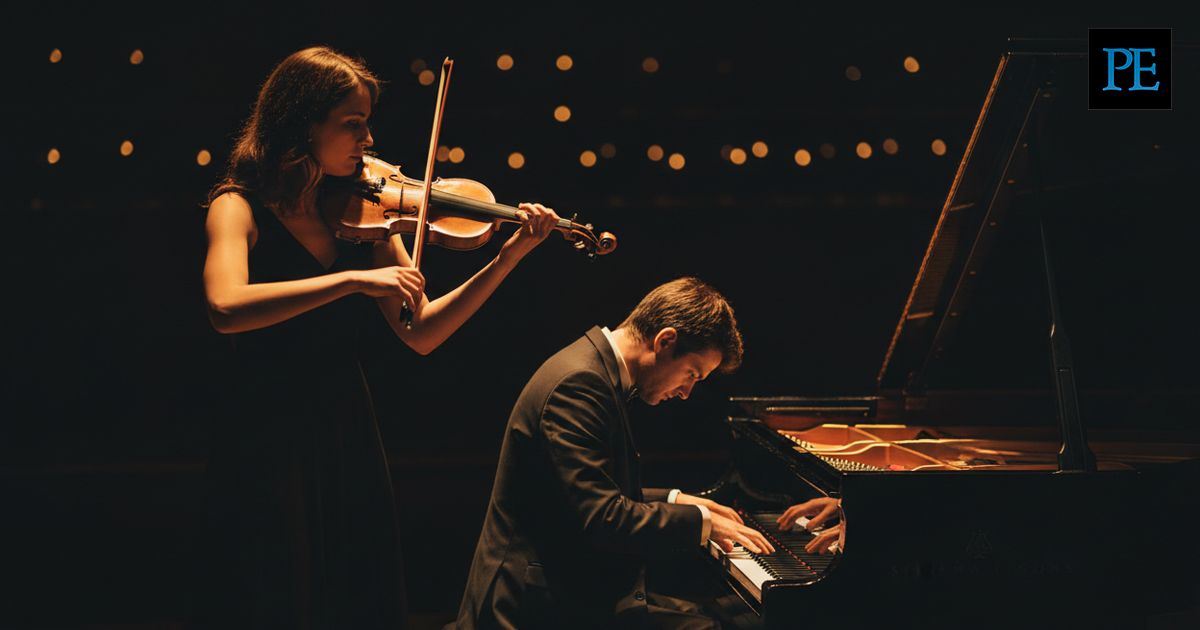
Stradivariazioni was commissioned by Martin Riseley and Diedre Irons for their 2011 national tour of New Zealand with funding support from Chamber Music New Zealand. The work is a theme and variations, with each variation cast in the form of a character piece. Instead of a single theme, three themes – or "ciphers" – are presented in the Tema (con amici) (Theme (with friends)). A musical cipher translates letters of the alphabet into musical notes which are then represented as melodies (or harmonies). The B-A-C-H cipher (B-natural, A-natural, C-natural and B-flat in German usage) first used by Bach himself, is perhaps the most famous. The three ciphers in Stradivariazioni are derived from the surnames of those who inspired the piece: Diedre Irons, Martin Riseley and Antonio Stradivari. Throughout the work the ciphers are manipulated and appear in varying permutations. Though not always immediately recognisable, the assorted combinations of the ciphers provide a sense of coherence and intimate relationship between the five variations.
The individual variations encompass the names of actual Stradivarius violins which are still in existence today. In each variation, I have attempted to capture the essence of either the physical attributes (the colour of the varnish, individual details of scrollwork and sound quality, for example) or the given name and historical background of the violin.
In Le Rossignol, I responded by evoking the nightingale's song emanating from within the shadows of a nighttime forest.
The Firebird simultaneously incorporates direct and distorted references to musical elements from Stravinsky's ballet of the same name.
"Ah, ça vorte violin est donc comme le Messie; on l'attend toujours, et il ne parait jamais." (Ah, that violin of yours is like the Messiah; one endlessly waits for Him, and yet He never appears). The great violinist Jean-Delphin Alard once uttered this statement in exasperation due to the fact that the owner of the 'Le Messie' violin, Luigi Tarisio, refused to let anyone see or play it. Therefore, it is in 'Le Messie' that I explore the themes of waiting and desire by utilising dominant-seventh chords which, even though they typically generate a strong expectation of resolution, remain unresolved in this context. This variation also integrates audible echoes of Wagner's Tristan Prelude, which is another work that portrays desire musically by exploiting unresolved harmonic tensions.
The Red Diamond violin, the name of which is due to its radiant ruby coloured varnish, is the subject of the fourth variation and also features a dramatic historical tale involving violent rainstorms, unexpected coincidences between friends and the restoration of the sand-encrusted instrument. The Red Diamond variation is thus a musical depiction of the dramatic storm and flood which resulted in the temporary loss, and subsequent refurbishment, of the 1732 Stradivarius violin.
The final variation of the work evokes the 1715 'Alard' violin, which was at one time owned by violinist Jean-Delphin Alard. The 'Alard' has been called the ne plus ultra of Stradivarius violins as it encapsulates tonal beauty, great volume and perfect articulation. All of these qualities are called into play in the final variation, in which the original theme (and its attendant ciphers) is reprised most directly in a rhapsodic epilogue.