Zeitgeist ("spirit of the age") is a personal reflection on the character of the arts today, music in particular. It is the result of an ongoing interest in cultural diversity and historical discontinuity, which are discernible characteristics of most of my work. By "historical discontinuity" I mean the approach to history whereby the artistic products of various eras are not viewed as successive links in a sequential chain, but rather as the pieces of a comprehensive puzzle, all of which are ever-present and functional in a timeless, multidimensional present. In this sense, Zeitgeist is a postmodern work: musical experiences from the past are taken out of their specific historical context and are assembled and juxtaposed in a way which reestablishes them as viable artistic experiences for here and now.
Formally the work is based on two short motives: the three-note motif which first appears unassumingly as the conclusion of an upwards moving gesture and the "French Overture" motif (dotted eighth-note followed by a sixteenth-note) which is pervasive in the Baroque-like music of the opening. The two motives combine into a larger five-note idea which appears almost ceaselessly throughout the work in various guises, from Shostakovich-like polyphony to takeoffs on disco music of the mid-late 70s and everything in between. This limited and clearly delineated structural framework helps to counterbalance the eclectic – and seemingly indiscriminate – exuberance of this work and build some creative tension between the audible surface and its internal architecture.
Food for thought as all this may be, I sincerely hope that the piece is enticing and meaningful to the musically less gluttonous audiences of today, who are becoming increasingly adverse to cultural spoon-feeding by the "serious music" establishment. Zeitgeist would have not been true to its name, had it failed in its effort to provide a balanced, low-calorie alternative to our information-saturated perceptual mechanisms. I believe that, ultimately, a work of art is in resonance with the spirit of its age when it fulfills some undefinable, yet widely agreed upon condition of relevance. I also believe that this condition is often divorced from contemporary prescriptions of "greatness", be it complexity, simplicity, old-sounding, new-sounding, and/or other recipes which come and go with time.
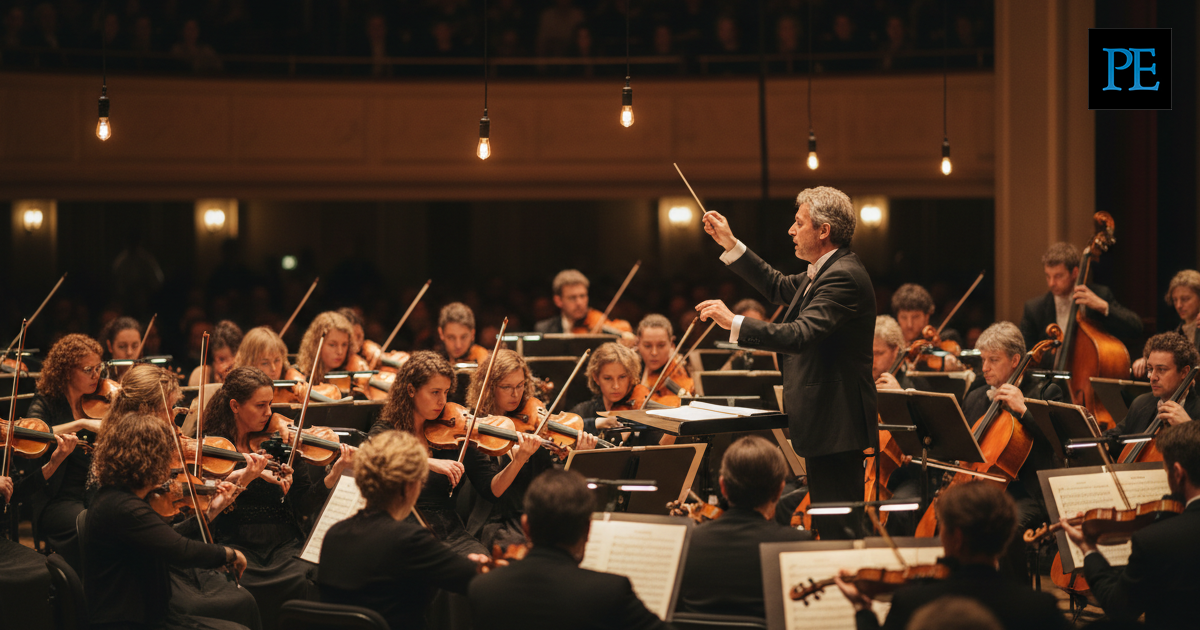
This substantial work intriguingly juxtaposes traditional baroque-like themes with new music, much of which is stormy and mysterious. Arresting in its unpredictability, its rhythmic appeal and the driving intensity conductor Anne Manson pulled from the orchestra made this a great opener.