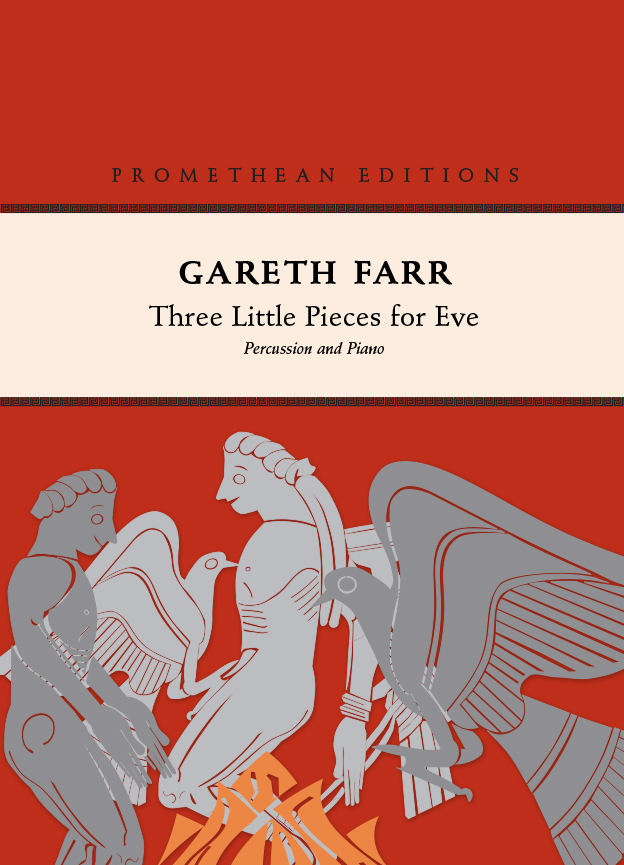
Three Little Pieces for Eve is a unique work in that it utilises unconventional percussion 'instruments': bottles, flowerpots and mixing bowls. Heavily syncopated chords in the piano are stitched together by a straight percussion part at the outset of the work. The discordant tonal quality of the alternating chords are duly contrasted by a short repeated figure which evokes a sense of childhood playfulness – a sound reminiscent of a ballerina music box.
The centerpiece of the work – II – provides musical 'breathing space' as the piano and flower pots unify rhythmically, executing a monophonic melodic line revolving around consonant tonal intervals – primarily perfect fourths and major seconds.
The registral extremes of the piano are harnessed as III launches in to a dialogue between forces. Rumbling bursts of rhythmic energy in the piano are interspersed by intricate gestures articulated across all three atypical percussion 'instruments'. Three Little Pieces for Eve culminates in the percussionist being required to play ad libitum across the range of bottles before a single note on the triangle is allowed to ring out over the same piano chord present at the beginning of the work.
I wrote Three Little Pieces for Eve as a tribute to my colleague and friend Eve de Castro-Robinson – a homage to her wonderful music that has always been an inspiration for me. My first thought was to pair instruments that are worth nothing ('junk' percussion: bottles, flowerpots and pans, about $12.50 in total) with an instrument that is worth more than most (a concert Steinway ($100,000 or so)). The question then is: which is the the more valuable musical sound; the cheap one or the expensive one?
I've paired up the complex and unpredictable tones of the percussion with different registers of the piano to create combinations of sound that clash and interact harmonically... and I couldn't resist the final irony of assigning a 'real' percussion instrument (triangle) to the last note of the piece. Being a percussionist myself, I am fully aware of the lowly (and undeserved) stigma this instrument has!