
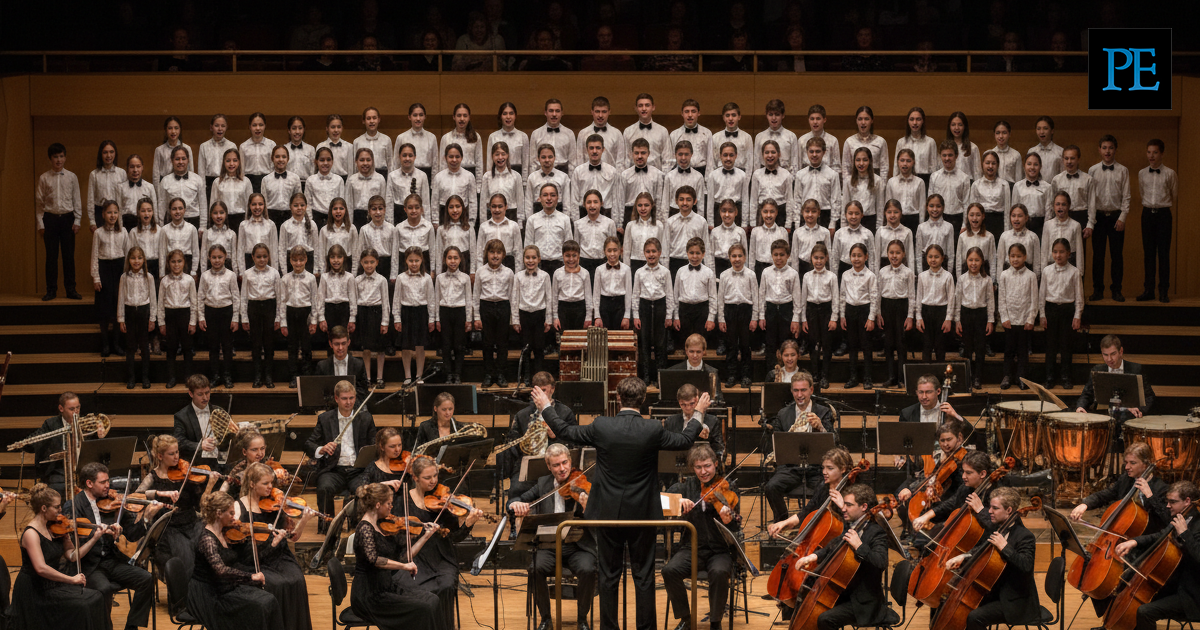
Channeling both tender adoration and the excitement of a new arrival, These arms to hold you flickers into life with repeated figures on glockenspiel, tubular bells and harp, their polyrhythmic interplay evoking a backdrop of wondrous energy while a solo violin soars and swoops above. A children's choir maintains the expectant energy with overlapping chants of "It's a boy"/"It's a girl", with castanets and temple blocks made curious and playful in this setting as they provide their bubbling rhythmic drive. The choir jumps between handclaps, glissandi and and ecstatic yelps before the work settles into a lullaby in compound time, Manhire's words of welcome made to sway softly. The previously spacious harmonic material becomes somewhat crunchy as melodic fragments of various nursery rhymes poke out, their lines reharmonised to comical effect. Typical observational notes from Plunket books are appropriated, incorporated into the choir's chants – "Steady progress, feeding well / bonny boy, bonny girl". Temple blocks, tambourine rolls and droplets of pizzicato strings accompany a climactic roll call of prominent figures in Plunket's past, with the rest of the orchestra joining the choir in their rousing "Thank you" before a full orchestral revisiting of the work's opening "It's a boy"/"It's a girl" passage pushes the work to a triumphant finale.
These arms to hold you was commissioned by the Royal Plunket Society for the New Zealand Symphony Orchestra, for its 2006 centenary. It is dedicated to my son, Cyprian, born in 1992 and was winner of the SOUNZ Contemporary Award at the 2007 APRA Silver Scroll Awards. A specific commission such as this called for a unique approach. When I was approached to produce a work for Plunket I was immediately keen to fete an organisation which had played such a vital role in the early months of my own baby. Peter Walls, who approached me regarding the commission, immediately sensed a creative compatibility with Bill Manhire, one of New Zealand's most stylish poets, and it was a happy collaboration. Meeting in his Wellington townhouse, Bill and I agreed we wanted to create something that combined a boisterous sense of childhood humour with a more reflective look at this fleeting stage in our lives and those of our children. I was also taken with writing for children's voices – an antidote to the virtuosic instrumentalists of my regular work. Early meetings with Nicola Edgecombe, Charles Bisley and the Lyrica Choir of Kelburn School were invaluable in gauging the abilities of the girls and boys whose ages ranged from eight to 12.
Bill created contrasting sections of text, which gave me a readymade structure: A Birth, A Welcome, Minding the Baby, A Lullaby, a Blessing, Thank-you. He was mindful to simplify the words in order to pack a visceral and emotional punch with monosyllables and telling phrases. We dug up old Plunket books from friends and family and Bill created an evocative vocal patchwork such as "swims on floor / rolls both ways / doing nicely / happy babbler", which I set as an ebullient hocketed chant, interspersed with clapping. A lullaby is the emotional heart of the work and I gave the children an easy part to memorise, a simple lilting melody. At solo sings the poignant lines "Here is a heart to beat with yours...Here are these arms to hold you / for a while", accompanied by gentle glockenspiel, harp and high solo cello. While setting the phrase, "Here are these arms to hold you", a great lump rose in my throat, and I knew I'd found the title.