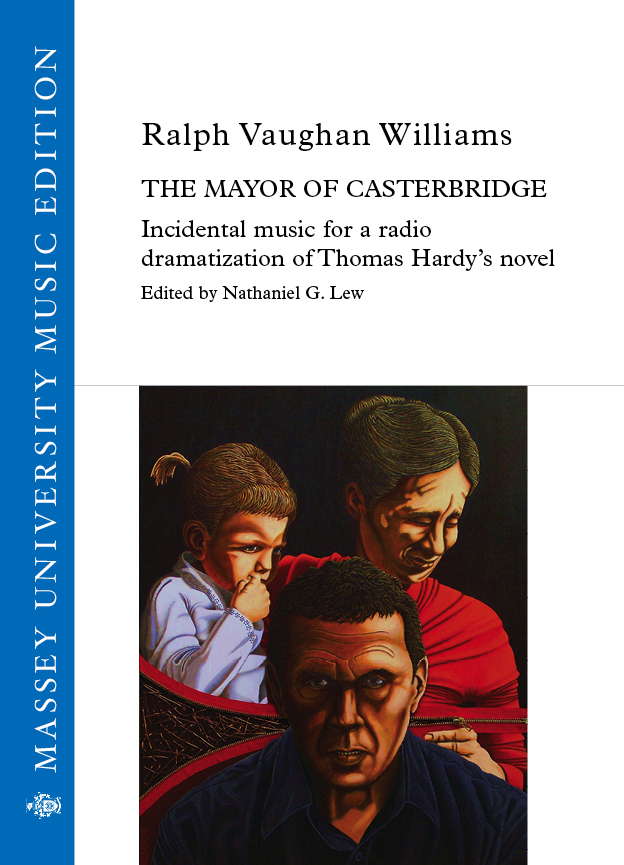
In 1950, the BBC West of England Service produced a radio dramatisation of Thomas Hardy's novel The Mayor of Casterbridge with a script by Desmond Hawkins (1908-1999). Owen Reed produced the programmes, which featured a cast of West Country actors. The BBC broadcast the ten thirty-minute episodes live from their Bristol studios on successive Sunday evenings from 7 January to 11 March 1951, recording them at the time of transmission. New Zealand Radio gave the programmes their second airing; these ran through Christmas and New Year 1951-52. The BBC rebroadcast them in the United Kingdom from 23 July to 24 September 1953.
In early August 1950 the BBC approached Ralph Vaughan Williams about providing orchestral music for the production. Preliminary discussions were, as Hawkins recalled half a century later, "in production technicalities - a main theme for opening announcement, with sections to conjure up particular atmospheres and scenes in timed sequences." The present edition was prepared from Vaughan Williams's manuscript, now British Library Add MS 50433.
The score is in three sections. Unsurprisingly, given the historical provincial setting, Vaughan Williams based the two main movements on a folk melody, in this case "On Christmas Night the Joy-Bells Ring," an Irish carol collected in South Staffordshire in 1904. It is perhaps odd that he chose a melody of Irish provenance for a novel by Hardy, but if he had ever been, by 1951 he was no longer fastidious about such matters, and most likely he chose the melody because its tone and orchestral potential were right for the project. (Years later, Hawkins incorrectly but understandably recalled that the song was from Somerset.)
The first movement, simply entitled "Mayor of Casterbridge" on the first page and "Casterbridge" thereafter, consists of a pick-up and forty-two bars, lasting just over two-and-a-half minutes. The movement presents the carol melody four times in contrasting settings: twice in A minor, then in a quieter form in C-sharp minor, and finally in a rhythmically squared-off version back in A. The second movement, entitled "Intermezzo," consists of forty-five bars. This movement has the same tonality and almost the same duration as the first movement, but a gentler tone, omitting trombones and timpani, and originally including a harp, although the composer struck it out. The movement begins and ends with a string background texture dominated by a rocking two-note figure. Vaughan Williams developed the melodic material from the first six and the last six notes of the carol; the clarinets dominate, building arching melodies from these motives that the full orchestra repeats.
An anonymous article on the production in the New Zealand Listener of 14 December 1951 (p.9) assigns narrative meanings to these two movements: "The sombre [carol] theme" of the first movement has an "underlying feeling of a relentless fate," while the variant in the second movement "is identified with the characters of Elizabeth-Jane and her mother – a peaceful, almost feminine theme…" Although such characterisations are broadly convincing, there is no evidence that they were the composer's plan. In particular, the description of the second movement refers to the opening and closing, but not the passage in the middle, which is more harmonically fraught than anything in the first movement.
Vaughan Williams reused most of these two movements in the Prelude on an Old Carol Tune, published in 1953 by Oxford University Press. Of the movements' eighty-seven bars, only twenty-three do not reappear in the Prelude, and are thus published here for the first time. The remaining sixty-four bars comprise the bulk of the Prelude, which is 103 bars long.
While recasting the Mayor of Casterbridge material structurally in this manner, Vaughan Williams preserved the musical substance of original movements with few changes. He altered harmonies and revoiced chords, particularly where new material blends into older material. Other than that he merely changed dynamics and articulation markings and thickened or thinned the scoring.
The third section of the Mayor of Casterbridge score is comprised of five separate phrases, entitled "Weyhill Fair A" through "Weyhill Fair E," of eleven, ten, eight, three, and seven bars respectively (a total of thirty-nine bars), lasting no longer than ninety seconds in total. These are fragments of background music, not a coherent musical whole, and call for the full brass contingent of the first movement plus several percussion instruments. Hawkins's script reveals the purpose of these brief phrases. In Episode One, during the drinking scene in the Furmity Woman's tent that reaches its climax with Michael Henchard's sale of his wife Susan, the script calls for a melodeon to play the "Weyhill Fair Song," and later for the cast to sing it. This song is particularly appropriate for the fair-time drinking scene since it originated as a toast sung to initiate new carters at the ancient Hop Fair at Weyhill, Hampshire, the very village where, under the pseudonym "Weydon Priors," Hardy set the scene. Hawkins even inserted a mention of the song's origins into the dialogue.
During Henchard's frantic search for Susan on the fairground the next morning, the script calls for four instrumental recalls of the song, for which Vaughan Williams provided the short phrases that form the third part of the manuscript, what the New Zealand Listener calls "a dissonant variation on a drinking song, used to convey the nightmare effect of Henchard's awakening to a realisation of what he has done in selling his wife." (It is unclear why Vaughan Williams composed five cues for the script's four.) He never quotes the Weyhill Fair Song in full, instead extracting motives from it. Cues A and E begin with chromatically distorted statements of the tune's opening bars, and all the cues except D share a tattoo-like falling arpeggio derived from the song's eleventh bar.
Little documentary evidence of the radio production remains. A few BBC memoranda, Hawkins's account in the Radio Times of 5 January 1951 (p. 11), and the New Zealand Listener article offer some background. Furthermore, a recording of the music survives from which however the first two movements have lost initial beats or bars and the "Weyhill Fair" cues are missing entirely. Most useful to our understanding of the music are the "Programme as Broadcast" records. Because the BBC gave each stock recording a unique identifier, these records identify the sound effects and pre-recorded diegetic music for each episode in considerable detail. Unfortunately, the BBC assigned a single code to all of Vaughan Williams's score (DBS 1972), and the broadcast records identify excerpts from this recording only by their duration, with no indication of which passages were used where. Most episodes appear to use one or two excerpts, with durations ranging from twenty-five seconds to over three minutes, but even this is unclear: where there is only a single duration listed, it may represent the combined duration of several excerpts. Based on the scripts and common practice at the time, we can assume that the excerpts were mostly passages from the first two movements played as opening and closing music. Where the script also calls for music to bridge scenes within an episode, a further fragment of one of these movements would have been appropriate. The New Zealand Listener article claims that excerpts from the second movement were "mainly used when Elizabeth-Jane's calm voice as narrator has ushered in a new phase of the story."
Against such a dearth of information, the script's non-diegetic cues raise unanswerable questions. Few BBC radio productions of the 1950s used extensive symphonic underscoring, but the broadcast record for Episode One reveals that some of the "Weyhill Fair" cues were played as Hawkins intended:
Music specially composed for the serial by Dr. Vaughan Williams, rec. 4.1.1951 DBS 1972, by BBC West of England Light Orchestra, conductor: Reginald Redman
Opening - 1'26"
Closing - 1'30"
Search themes 1'12"
Total 4'12"
The phrase "Search themes" must refer to the reminiscences of the Weyhill Fair Song, and their identification as part of DBS 1972 shows that they were Vaughan Williams's music. But the "Weyhill Fair" music is an anomaly. Henchard's search for Susan is not the only scene with non-diegetic music. Indeed, although Hawkins never again "calls the tune" as in Episode One, he specifies underscoring in vaguer terms at later moments of high drama. In Episode Five, for instance, he calls for music when Henchard opens Susan's letter revealing that Elizabeth Jane is not his daughter. However, Vaughan Williams wrote no more music for the production, nothing he composed is appropriate for this moment, and the broadcast record for Episode Five mentions no orchestral music other than DBS 1972. Did the producers simply ignore music cues after Episode One, or did they do their best with what Vaughan Williams had provided? The first two movements are uniformly broad and neutral in tone, while the nightmarish quality of the "Weyhill Fair" music – not to mention its specific associations with Henchard's drunkenness – would not work in Episode Five, or indeed in most other similar points in the production.
The question is complicated by a memorandum dated 6 March 1951, in which the BBC producer Douglas Cleverdon writes: "I have spoken to Owen Reed concerning Vaughan William's [sic] music for ‘The Mayor of Casterbridge,' and I gathered that V.W. was not only most co-operative, but also very efficient in the technical matters relating to timing and so on." (Indeed, the composer, conscious of the timings of the movements, marked the elapsed time at the end of some of the systems in the manuscript; the New Zealand Listener describes him composing "with a stop-watch in his hand.") Timing is most sensitive in short cues in the midst of scenes, less so at the start and close of episodes where music is faded in and out as necessary. So Cleverdon's comments could refer to the "Weyhill Fair" cues in Episode One. On the other hand, Cleverdon could mean that Vaughan Williams didn't mind having passages from the first two movements excerpted, and that he had deliberately made this easy; certainly, these movements were rarely if ever broadcast in their entirety. We are left with an enigma: some fine music, but little sense of how it fits with the script, and several points in the script with no suitable music at all.
Since the manuscript is legible and mostly free of errors, only two details deserve special mention: (1) In bar 23 of the first movement, for two quavers, the violins' tremolando harmonies differ from the corresponding bar in the Prelude on an Old Carol Tune. The earlier version is equally coherent if not preferable, the difference due either to Vaughan Williams's revision or copying errors in the Prelude. (2) The harp part in the second movement stops abruptly at the end of bar 35, where one or two more beats might be expected. The composer seems to have changed his plans mid-stream; no harp plays in the recording. For reference, I have included the part in the present edition.
Beyond these matters, the preparation of this edition has required merely the rectification of slips of the pen, regularisation and addition of haphazard or missing markings, and occasional replacement of cresc and dim with hairpins.
—Nathaniel G. Lew