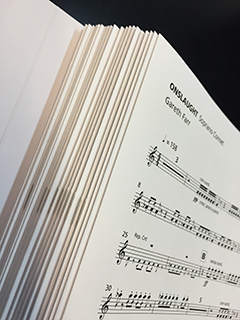
Farr's imaginative score for The Bone Feeder melds exquisitely with playwright Renee Liang's libretto, which tells the story of Ben, a young New Zealand Chinese man attempting to trace his ancestry. Ben's journey of discovery reveals stories of love, tragedy, and betrayal, with an overarching sense of unresolvedness due to the 1902 sinking of a "coffin ship" in the midst of repatriating 500 Chinese bodies to their homeland. The mixed ensemble that Farr brings together for The Bone Feeder features three instruments from three different cultures: Chinese classical instruments the dizi (flute), the erhu (fiddle), and the guzheng (zither); Western classical instruments the violin, the cello, and the marimba; along with taonga pūoro (Māori traditional instruments). From this exotic combination of elements, Farr conjures up haunting soundscapes, dramatic accompaniment, ceremonial ambiance and more as Ben encounters ghosts of the past who guide him through his feelings of cultural rootlessness.
I have spent my career dreaming of writing an opera, and striving for new and interesting ways to combine the music of different cultures. When both dreams materialised in a commission from the Auckland Festival for The Bone Feeder I was beyond thrilled. 2016 was a year of discovering the classical instruments of China, and I have fallen totally in love with them and the rich repertoire of music and drama that they have led me to.
Farr's music is all texture and mood, and its textures and moods are wonderful: timbres mingle and shift in ways that are at once fascinating and symbolically appropriate.