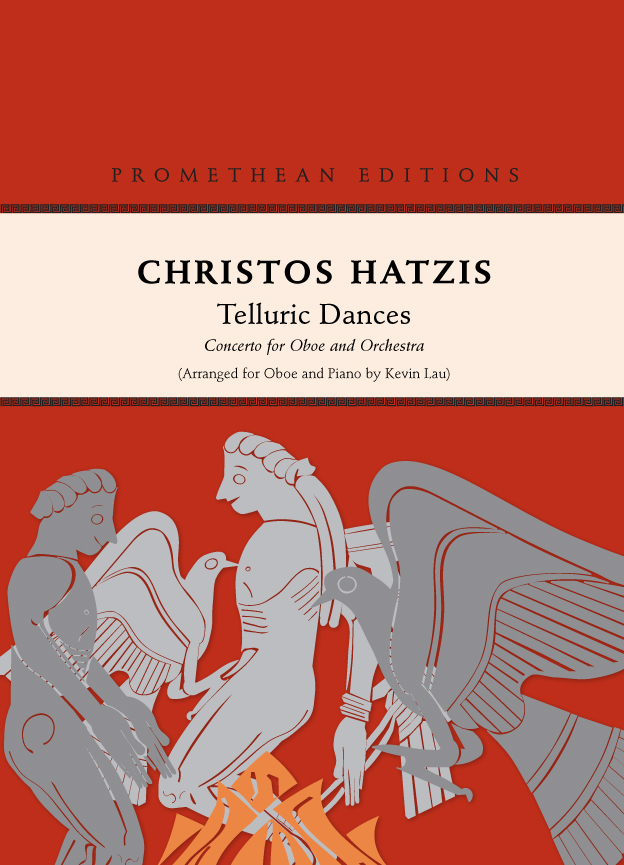
Originally a work for oboe and orchestra, Telluric Dances appears here arranged by Kevin Lau for oboe and piano.
Two different requests for an oboe concerto brought Telluric Dances into being: one by Joseph Salvalaggio, a young Canadian oboist living and working in the USA and one by Symphony Nova Scotia for Suzanne Lemieux, their principal oboist. Telluric ('Earth') Dances is in three movements, and the music makes extensive reference to tonal modes and popular dance forms from the Balkans and the composer's native Greece in particular. Some of these modes and dances have their origins in Turkish and Arabic music, but Hatzis recalls that his first encounter with them was in the Greek night clubs of Toronto where he made a living playing in local bands during his early years as a composer.
Snake Dance is based on the chiftetelli, a common dance form originating from the Eastern Mediterranean. A slow introduction eventually transitions in to the first dance of the work, which exhibits virtuosic oboe passages supplemented by improvised percussion and 'unconventional' orchestral devices. A cycle of contrasting tempi is repeated as the harmonic centre begins to shift, drawing on musical references beyond that of the Eastern Mediterranean motifs prevalent in the opening section of the work. The movement concludes with an extended, technically demanding solo oboe cadenza.
The second movement, Eagle Dance, is a passacaglia based on a nine-beat rhythmic pattern known in Greece as zeibekiko – an improvised dance (originally performed by men) characterised by very sudden and unexpected movements. A common pose of the zeibekiko involves stretching one's arms out and dropping the hands, while testing the limits of the dancer's balance, "like an eagle in mid-flight" –hence the title of the movement. The repetition of rhythmic patterns and melodic content is intensified as elements of the orchestration build and create a sense of increasing momentum. A sudden harmonic shift with new melodic material supported by lyrical, rich harmonies (reminiscent of the cinematic music of Hollywood) occurs, and is eventually combined with the reintroduction of the original melody and rhythmic components of the zeibekiko. As the movement concludes, the rich, cinematic material dissipates and the stark qualities of the opening material are recapitulated by the oboe and bass drum.
The foundation for the final movement, Dancing in the Light, is a common Balkan folk dance in 7/8. The primary thematic material gradually settles in to the 7/8 meter before mutating through a variety of rhythmic structures based on asymmetrical permutations of twos and threes. Contrasting textures emerge, alternating between the soloist and intense outbursts from the orchestra – the music at this stage being episodic and exuberant. References to the Eastern European national schools of the late 19th and early 20th centuries occasionally shine through in this otherwise monothematic movement. Before the conclusion, an improvisatory section is featured. Fast unison passages between the solo oboe and orchestra, which eventually culminate in a theatrical 'breakdown of communication' between the soloist and orchestral musicians, bring the work to a close.