Eclectic and sophisticated, Ritchie's String Quartet No.2 opens boldly with the swung compound-time rhythms that dominate the first movement. Smatterings of staccato, strong accents and pizzicato emphasise the movement's edgy quality, even in its occasional hushed passages. Though the energetic rhythms of the first movement relent for the second movement, a familiar harmonic tension remains, its unease contrasting with the gentle sway that supplies the movement's rhythmic foundation. Dynamic heaves and sighs intensify a sense of vulnerability, which is further articulated by the expressive rawness of the violin's melodic line that features in the latter half of the movement. Dominated by a four-semiquaver rhythmic figure, the third movement sees the string quartet passing this figure between one another, along with more melodic quaver-based material. The darkness lifts somewhat, creating space for a waltz-like statement by the first violin, though soon enough we find ourselves returning to the shuddering semiquavers, as they drive us to the end of the movement. The influence of folk music is audible in the work's final movement, particularly in the viola's lively theme and the cello's percussive pizzicato material. Motifs from the previous movements find their way into the work's final minutes, as a transition to triple time takes place. The dark undercurrent that pervades much of the work is mustered a final time, propelling the work to its feverish conclusion.
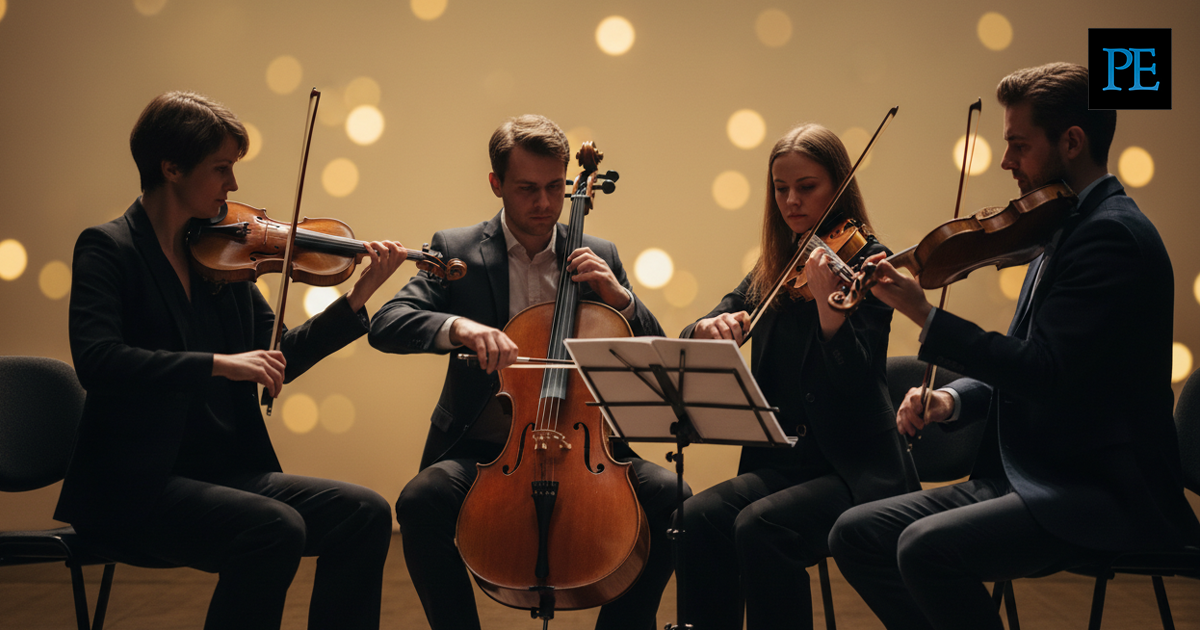
This quartet was commissioned by the Nevine String Quartet, an ensemble of players from the New Zealand Symphony Orchestra comprising Liz Patchett, Janet Armstrong, Peter Barber and Robert Ibell, now disbanded. It was premiered in Osaka, Japan, in 2003 and subsequently performed by the Nevine Quartet, including on a Chamber Music New Zealand tour in 2009. The quartet then recorded the work for the album Octopus: Anthony Ritchie Chamber Music (Atoll, ACD 112), which was released in 2011. Although abstract in content, this quartet contains some underlying extra-musical ideas that inform the music.
The first movement is dominated by energetic compound meters and rhythms and motivic ideas. Measures 1 and 2 present the motif C-sharp–B–D–E, which is answered with another motif of F–E–D–G–G-sharp in measures 5 and 6. These two motifs appear elsewhere in the work and act as a unifying device. For example, measures 39 and 40 of the second movement, measures 108-110 of the third movement, and in triumphal mood for measures 273–276 of the fourth movement. These motifs and others are derived from a magic square, in an abstract process I first used in 2001, in my Piano Preludes. This particular four-sided magic square is famous: it appears in the woodcut by Renaissance artist Albrecht D√ºrer, entitled Melencolia (1514). In the woodcut, the magic square can be interpreted as representing reason; however, imagination and emotion take precedence over reason in the realms of music and art. The portrayal of a depressive character in Melencolia also has resonance in this string quartet, especially in the slow second movement, which is almost the flip side of the somewhat manic first movement.
Another important motif in the first movement is the combination of two semitones a minor third apart (the 1:3:1 motif). For example, this appears as a harmony in the second main theme at RhB, followed by a cello motif in measure 56. It also appears earlier at RhA, expressed as minor sixths a semitone apart: here, the motif is a striding, relentless ostinato. The opening theme returns at measure 90, before ideas are discussed in a developmental section. The ostinato returns at measure 157, leading to a varied recapitulation before the music fades in exhaustion to a quiet conclusion.
The tempo indication for the second movement is "Like a lullaby". The music has a quiet rocking motion and is pervaded by minor thirds, a common interval in children's songs. This minor third, appearing in the cello at the start, is also part of another occurrence of the 1:3:1 motif – see the first and second violins in measures 1-3. A second theme appears at RhK in the first violin, accompanied by 1:3:1 harmonies. This expressive melody is later played intensely by viola at measure 66, leading to a harrowing climax at measure 85. The music suddenly dies again, and ends with a hushed return of the lullaby theme, this time with a wandering descant in the first violin.
The third movement is a vigorous ternary form, with the outer sections being astringent and dominated by fifths and fourths in the harmony. Melodic lines are angular and restless. By contrast, the middle section is simple and calm in mood, with a folk-like waltz in the first violin (measure 76). It morphs into a recapitulation of the opening section, where the buffeting rhythms and astringent harmonies are heightened, finally resolving onto a D lydian chord at the end.
Surprisingly, the finale opens with a reminder of the folk-like waltz from the third movement, with all instruments muted. This is like a dream before the awakening to reality. The allegro molto at measure 16 heralds the start of the main part of the movement, with a rustic theme on viola based on the scale G–A–B-flat–C–C-sharp–D–E–F. It becomes more overtly folk-like at RhW, accompanied by viola and cello playing pizzicato and col legno. The driving 4/4 meter is eventually replaced by triple time and a quirky second theme at measure 101. The main theme returns, and is followed by a three-part canon at measure 163, and further development of ideas. Following the final statement of the main theme, motifs from the other movements begin to invade the texture, starting at RhD1. The poco meno mosso at measure 273 is a Coda, bringing the work to a frenetic close.