Look to the Far Horizon is introduced with a series of hushed, tender chords imbued with a sense of inner movement due their four-against-three beat divisions. The quartet then gradually separates into more contrapuntal individual lines, eventually arriving at the work's first imitative section, its wave-like contours passed swiftly between players, cells of rhythmic and intervallic material from the work's earlier material germinating all the while. More aggressive dynamic and rhythmic interruptions occur, and dissonant tonal territory is explored. A quieter lento passage allows the viola to smoothly sing in its upper register, followed by a transition to compound time featuring an expressive violin solo. The work then retraces its steps, passing through its second section once again before settling on the beautiful chordal material of the beginning.
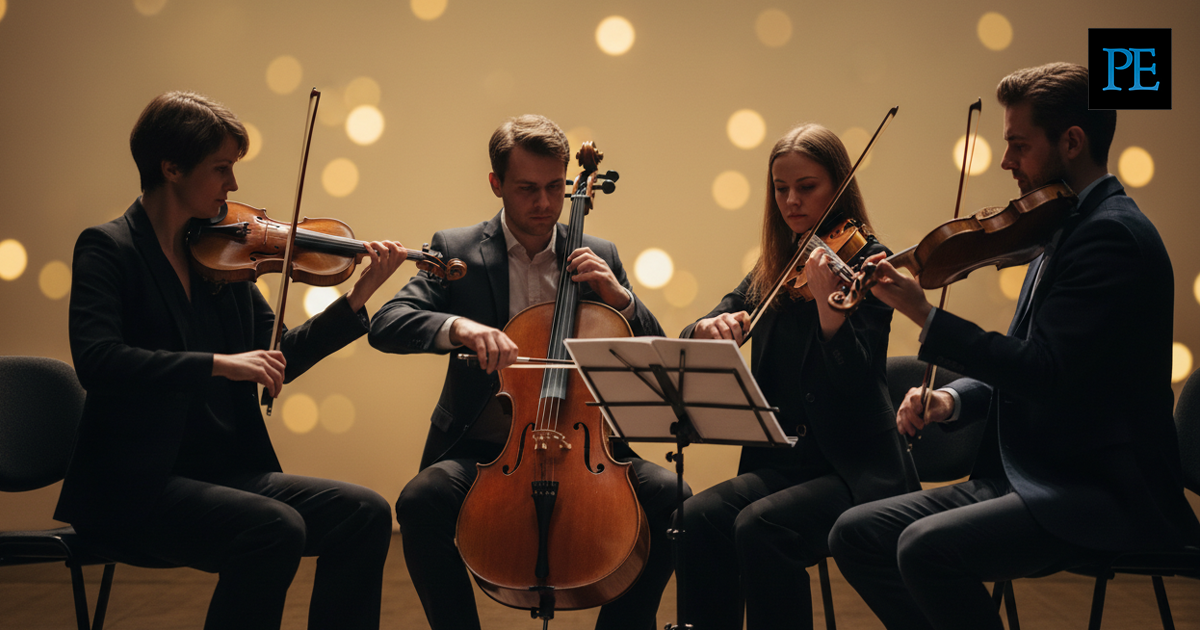
Look to the Far Horizon was written between April and June of 2015, for Auckland's Jade String Quartet, who premiered the work at the Pah Homestead in September of that year. The work is not programmatic but attempts to capture some of the atmosphere and character of the skies and seascapes surrounding my home city of Dunedin, New Zealand, and the nearby Otago peninsula – a place famous for its albatross nesting grounds, penguins and other wildlife. It's a landscape where sea meets sky, seabird cries abound and the cloud formations drift past quickly, blown by strong winds.
The work is structured in a large arc shape with a centre (the heart of the work) containing a string of variations that constitute several contrasting sections. These central variations are flanked by outer sections of imitative entries and counterpoint, which in turn are flanked by an introduction and coda.
The work opens with gentle clusters in which I was thinking of the typically bleached skies and clouds of the Otago environment. A simple modal tune introduces the building block from which everything is derived: a rising third interval followed by a rising second, combined with a short note-long note rhythm. Later in the piece, the minor third is at times developed into a major third – often two major thirds separated by a second – and the second at times becomes a semitone, oscillating and fluctuating like sand blown on the wind. The short note-long note rhythm sometimes transforms into a clipped "scotch snap".
The second section opens with a refrain quoting the aforementioned building block (a recurring hint at the mass of the cloud), followed by upward close imitative entries that could represent shags and other seabirds taking off in close formation.
Upper-register interruptions in biting, bracing harmony might suggest the shrieks of seabirds in southerly winds. The main central section consists of a set of variations derived in some way from earlier material. There are many ideas – all of which develop the pitch and rhythmic motifs already presented. A graceful, calm variation of tide-like oscillation is followed by a loud, dramatic section, which is in turn followed by a slow, soulful variation in which the viola presents the melody (constructed from the seemingly less significant interval of the perfect fifth that was also part of the work's opening material).
Following this, a lilting 6/8 passage presents two themes: the first, an eight-measure violin tune, is a graceful, lilting melody inspired by the flight of the albatross, while the second theme develops this with scotch snap figures in a sort of slow jig (the Scottish influence on Dunedin?). There are some dissonant interruptions by the shrieking seabirds. The work ends by coming full circle with a recapitulation of the second section, with its refrain and imitative entries, before concluding with the opening material evoking the sky and its play of light in cloud.