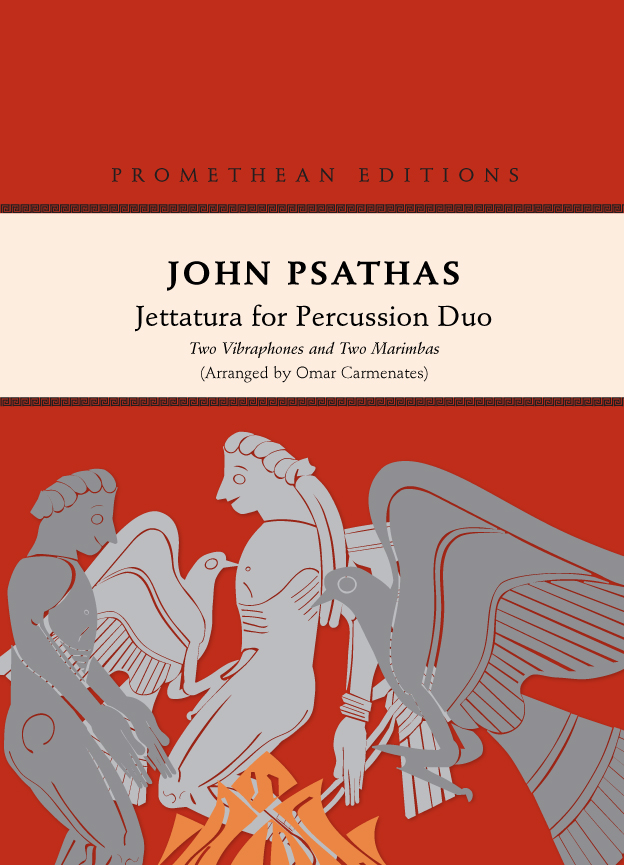
This arrangement of Jettatura by Dr. Omar Carmenates, Associate Professor of Percussion, Furman University, USA, is from a collection of Psathas' works arranged by Carmenates for percussion ensemble entitled The John Psathas Percussion Project.
Carmenates' intricate arrangement of Jettatura (originally a short, uncomplicated moto perpetuo for piano (PE029) tests the capabilities of the percussion duo just as much as Psathas' original version challenges the pianist. Here, the percussionists must keep precise time to navigate Jettatura's rapid-fire waves of notes, which can find themselves fragmented and dovetailed between instruments. The rumble of the piano's lower register is supplanted by the damp, woody resonance of the marimba's lowest octave, while the vibraphone's mellow timbre features in the work's more subdued middle section. Standing out most, however, is the punchiness of the marimba's middle-to-upper register, which dominates the animated outer sections of the work, maintaining the bold character of the piano version.
For a country that is home to me in so many ways, Greece has not been so kind to this particular absent son. Practically every journey I have made there has left me with a permanent reminder of some unpleasant and often bizarre experience. From donkey bites to the groin, to motorbike accidents on the island of Santorini, to a protracted, salmonella-induced weight loss that would have made Jenny Craig's eyes water, it is not surprising that members of my family there began to imagine I had fallen under the influence of someone's evil eye.
An expedition to Greece in 1998 brought an unprecedented onslaught of bad luck, this time involving my wife and son. My dear, concerned, sister went to the village expert in such matters to discover if I was inflicted with the evil eye (also known as mal occhio, or jettatura). Jettatura is the ancient belief that the gaze of strangers casts unwanted magic into the lives of the innocent. The belief is that a person – otherwise not malefic in any way – can harm you, your children, your livestock, merely by looking at them with envy and praising them. The soothsayer, when checking my aura by long distance (these days such matters can of course, be conducted over the phone via free-call numbers), gasped, went silent, and declared I was so heavily and completely hexed that my halo was utterly opaque.
In Greece there is a talisman one can wear, or place in a car, house, or shop, which protects against the evil eye (in some countries, one must protect oneself against false compliments by spitting on the person who proffers the compliment). This talisman is in the form of a glass blue eye, a "good eye". Jettatura, written upon returning from Greece, is my talisman, my good eye.
This piece is dedicated to my sister Tania, who tried in her own way to protect her kid brother from jettatura.
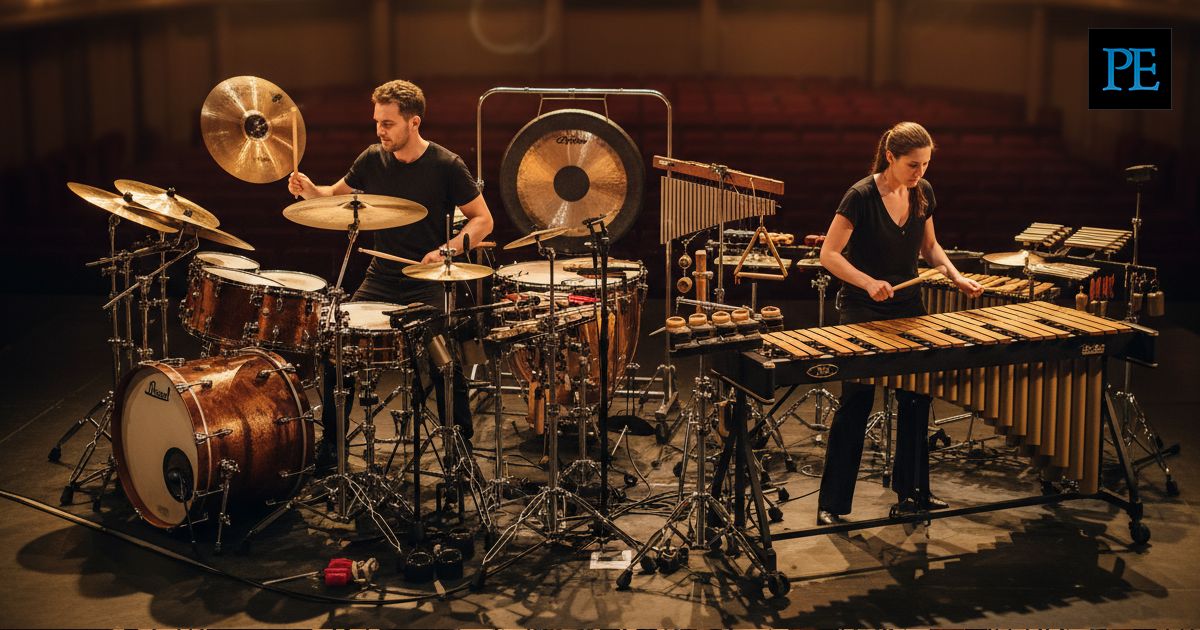
Much like my arrangement of Matre's Dance for Percussion Ensemble from this series, this arrangement of Jettatura for Percussion Duo seeks to maintain the stark color palette of the original version (piano only) by primarily utilizing wooden keyboard percussion instruments in lieu of the piano. The vibraphone voice is added throughout to bring out melodic lines or ostinati where a longer resonance or timbral contrast is necessary. This arrangement also utilizes a multi-keyboard setup wherein each performer plays both a 5-octave marimba and a standard 3-octave vibraphone. A diagram of the suggested arrangement of these instruments is provided below but other arrangements are certainly possible.
In order to perform the piano version of Jettatura convincingly, the piano part requires periods of sustained rhythmic intensity in all registers of the instrument. In order to capture this energetic quality with two performers using only eight "fingers" (mallets) – instead of one performer with ten fingers – a rather dense and tight hocket is utilized in the outer sections. Here, the rhythmic, harmonic, and melodic lines are constantly traded between the players. In the middle section, each performer gets an extended opportunity to carry the lead melodic lines while the other accompanies with ostinato-like material on the vibraphone. Due to the rhythmic difficulty created by these devices, a tight sense of ensemble interaction and rhythmic stability should be prioritised when performing this arrangement.
I'd like to thank my friend and colleague Brian Nozny for his editorial, musical, and spiritual advice throughout the process of arranging and recording these works. Of course, the biggest thanks of all goes to John Psathas himself, for allowing me a small glimpse into his musical genius by letting me be a steward of his work. Thank you John for all the years of collegiality and friendship.