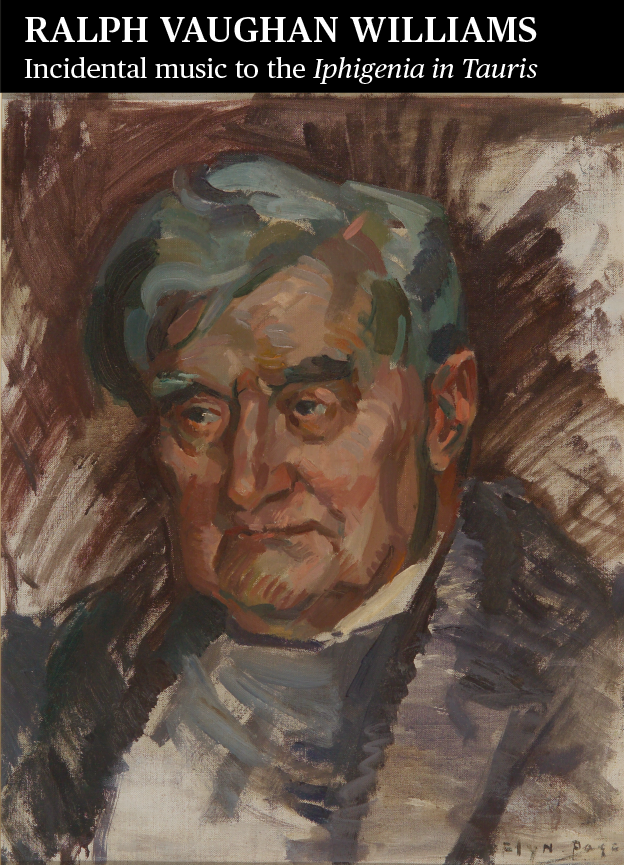
Ralph Vaughan Williams' first musical foray into Greek plays was his incidental music to Aristophanes' The Wasps, presented by Cambridge University in 1909. The production used the original Greek text, as is still the tradition there, though English translations of the plays were becoming popular at the time, amongst them those by Gilbert Murray, the Oxford University Professor of Greek.
In 1911 the dancer Isadora Duncan asked Murray for permission to mount three of his versions of Greek plays, with her brother Augustin directing. Murray had been advised by his friend Herbert Fisher that "my brother-in-law Ralph Vaughan Williams (who is a musical composer and therefore prejudiced) would like to see a big orchestra and some frankly modern music." Vaughan Williams in his late thirties had actually previously written to Murray: "May I say how much it has distressed me to hear those wonderful lines in Elektra [sic] and your other plays mauled about by (as it seems to me) quite the wrong kind of musical setting."? The musicologist Henry Hadow had also recommended Vaughan Williams: "a very good musician - also keen on poetry and full of understanding." When Isadora Duncan finally met Vaughan Williams and danced for him, he immediately found "the melting beauty of her phrasing" exactly the sort of movement for which he could write.
As he began work on the plays, Vaughan Williams wrote to Murray, stating:
"there is nothing I should like better than to be associated in such a production as you foreshadow - however problematical it may be. I have had several shots at some Electra music and have found the task much harder than I thought - I cannot make up my mind what sort of music would be best and naturally until I can do that the music itself refuses to come. However your letter has excited me so that I believe my imagination is beginning to work."
In a later letter he becomes more specific:
...the problem gets more insoluble the more I work at it. I tried setting them in the way I suggested to you - a sort of chant without any accompaniment - but it did not seem to work altogether - I have tried other parts in a more operatic method - the result is rather a mixture - the only way I think will be a sort of trial performance of some of the music when it is ready. I can't hope to satisfy you and Miss Duncan and Augustin (who wants the choruses spoken!). I want to ask you a lot about the Bacchae choruses - whether all the big choruses should be sung throughout - or whether parts spoken - and what bits should be murmured and what parts declaimed.
The trial performance of the three scores finally happened, with a subsequent public performance of the music taking place at London's Royal Court Theatre on Friday 31 May, 1912. In its 25 May Musical Gossip column, English newspaper The Globe included a preview of the performance, with the prescient remarks:
In connection with Mr Vaughan Williams' musical setting of choruses from Euripides, to be given at the Court Theatre next Friday, we are informed that "they are an attempt at something new, and something which is neither German nor French. This music is no experiment in style. It would seem, rather, as though the composer had disclaimed all styles and all schools, and found direct inspiration in the material of the poet's inspiration, and the result is something of undeniable beauty." A chorus from 'The Electra' and from 'The Bacchae' and four from 'Iphigenia in Tauris' should make up a programme of interest.
Iphigenia is more of a romantic or escape play than a tragedy. It begins with a tragic atmosphere, but arrives at a happy ending. Iphigenia is exiled, with an intense longing for home and a bitter rage over her circumstances. The mezzo-soprano soloist takes Iphigenia's part, with the chorus taking the part of the Greek chorus commenting on the action. Some lines are set as solos for members of the chorus.
The bare bones of the work were completed by 4 January 1912, when the composer wrote to Murray: "I have now sketched out the music for your "Iphigenia" for the Liverpool people - there has not been time to do anything very distinguished - but I have made it very simple & tried to get the declamation right." However, having already worked on two of the plays, The Bacchae (PEV02) and Electra (PEV03), and experimented musically with regard to the declamation, Vaughan Williams was by now very confident in his setting. No full score has ever been found, but the score was definitely intended for a staged performance of the entire play, as textual cues are given before the four musical numbers that follow the prelude, which itself contains the direction 'Curtain rises'. However, the projected Liverpool performance never took place.
There exists a short score - merely a piano accompaniment with the vocal parts - though it does list the instruments in the orchestra. Occasionally the composer gives indications for desired orchestration (as detailed below) but the only parts that have survived are vocal parts. Tempo directions, metronome marks and rehearsal marks are all the composer's. On this short score various conducting indications in the composer's hand are written in blue pencil, e.g. "slightly slower", which I have included in the printed score.
—Alan Tongue, Editor