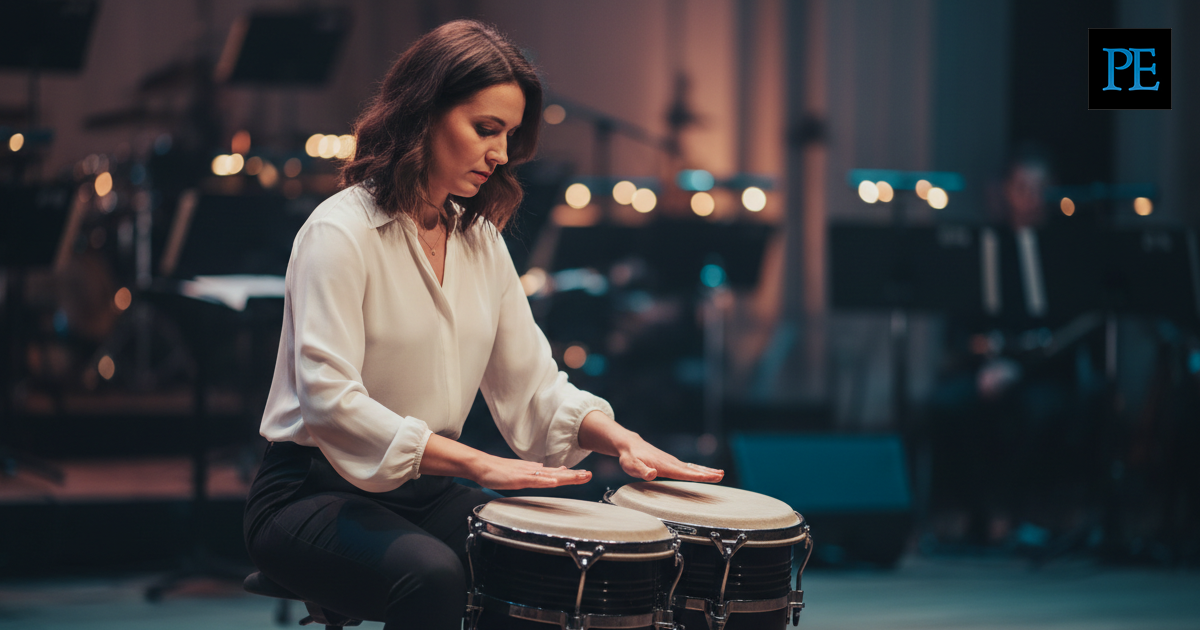
Brief yet virtuosic, Farr packs a range of playing techniques into Fifty Fifty, with the player initially having to alternate between striking with a finger and mini maraca in the left hand, all the while sustaining a roll with the right. The simmering suspense of the opening bars breaks out into a passage of rapid-fire and odd-metered drumstick work peppered with propulsive accents and nested tuplets. A relatively spacious middle section follows, its subverted, syncopated shuffle accentuated by the returning mini maraca. The work then pushes toward its conclusion with a return to the drumstick-driven material, which now requires the player to negotiate controlled dynamic swells and dips en route to its fortississimo climax at bar 50.
Along with 49 other composers around the world, I was asked by Dame Evelyn Glennie to write a piece for her 50th birthday in 2015. The concept was fascinating – 50 successful living composers each write a 50-bar piece for a solo percussion instrument.
Evelyn's decision to make the piece for one instrument only was partially to make the project creatively challenging and logistically practical, but also as a good opportunity to diversify the repertoire outside of multi-instrument setups. I approached the project with immediate glee simply because of the mathematical part of the concept, but then of course got very excited with thinking up ways to make solo bongos (the instrument she chose for me) deliver a satisfying piece of music for the audience – with contrast, drama, subtlety, and excitement.
I used as many playing techniques as I could think of to achieve the contrast element of the piece - playing with fingers, drumsticks, mini maracas as drumsticks, and combinations with each hand playing a different technique. The drama, subtlety and excitement come from the concept and form of the piece – it starts pianissimo and rhythmically free and builds up to a fortississimo and rhythmically complex climax.
The piece was originally going to be called Leth-Cheud - Rima Tekau, meaning "Fifty Fifty" in Scots Gaelic and NZ Māori, but I realised that it would end up being the one piece of mine that no-one ever pronounces correctly, so I settled for Fifty Fifty, which is a nod to the name of the whole project – 50 for 50.