It is a pleasure to sink into the personality of a special work and enjoy its company at one's own pace. Like Ralph Vaughan Williams's The Lark Ascending or Carl Nielsen's Springtime on Funen, Douglas Lilburn's Drysdale Overture has a succinct motif that, along with its personality, has helped it to be recognised as quintessentially New Zealand. The 'exhilaration of being in open spaces' is Lilburn's description of a work that can be heard as an expression of an optimistic new country experimenting with its founding creed of rugged individualism. Lilburn is after rapture and perhaps the most vivid expression of rapture ever written in a New Zealand musical work is the central hymnal passage, which grows from a beautiful oboe solo heard in the exposition, evoking the Scottish lullabies that Lilburn heard his mother sing. This is music we can still thrill to because there's more to it than nostalgia. Drysdale Overture is at once an account of a New Zealand farm-scape, and a declaration of independence with 'the feeling of exile basically built in'. Vibrant, muscular, and quietly searching, it remains a persuasive New Zealand argument for simplicity of life and clarity of conscience – an argument Lilburn evolved and distilled throughout his creative life, from the expression of wonder in the alpine panoramas of the Second Symphony, to the campfire meditations of Sings Harry, to the Lake Taupo reverie of Soundscape with Lake and River.
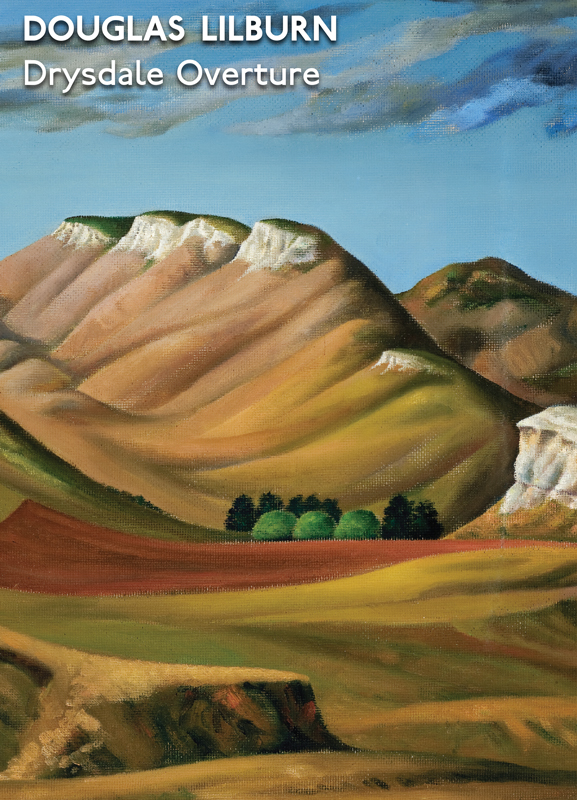
Lilburn composed Drysdale Overture in 1937 when he was a student of Ralph Vaughan Williams at the Royal College of Music in London. Although he labelled an overture (in the sense of a self- contained concert piece), Lilburn preferred to think of it as a tone poem depicting summer days on the farm back at home. It is essentially a tribute to the landscape of Drysdale Station, a sheep farm in the Upper Turakina Valley, which Lilburn's father (to whom the overture is dedicated) originally cleared from the bush. As a child growing up at Drysdale, Douglas Lilburn fished for eels in the river, floated on log canoes, and built reed wigwams. Listening to the precipitous introduction of Drysdale Overture and the ensuing exposition that at first simulates a winding river, one can imagine a green valley with the sound of splashing water and with hills rising steeply from every side to a far-away blue sky. The middle section, preceding the rapturous passage at the heart of the work, repeats in accordance with rondo structure, to create an episode that accumulates in orchestral strength and weight, so that what began as a light sound ends up as a dense one. The effect bears comparison with kayaking downstream from shallows into deeper water. The return of earlier ideas in reverse order ends the work as it began.
Drysdale Overture aroused interest at the Royal College of Music where the first (i.e. foremost) orchestra performed it in 1938. Lilburn then made minor revisions and entered the piece into the New Zealand National Centennial Competitions for new musical works, where it won first prize (of seventy pounds) in the orchestral category. Along with other prizewinning works (including Lilburn's Festival Overture and Prodigal Country), Drysdale Overture was given a live national broadcast, which took place in the 2YA studios in Wellington on 23 November 1940, with the National Broadcasting String Orchestra and the 2YA Concert Orchestra conducted by Anderson Tyrer. Lilburn, who had returned from London, was an invited guest along with the Prime Minister, Peter Fraser, and other dignitaries. But after this occasion Drysdale Overture was pretty well forgotten for nearly fifty years, until John Hopkins and the New Zealand Symphony Orchestra premiered a revised version of it in the Wellington Town Hall with a direct broadcast, on 20 May 1987. Now it is accepted as an important work.
Asked by John Hopkins why he thought Drysdale Overture had been neglected for so many years, Lilburn replied:
Partly I think because it wasn't terribly well put together in the initial stage and, when opportunities came for performance of a work with the orchestra, there were other works waiting - the two overtures [Festival and Aotearoa] and, later, three symphonies and several other pieces written for orchestra, so these took precedence all the time. It wasn't really until Peter Nisbet [the NZSO's General Manager] last year mentioned that he would like to do this work again in this series of concerts, that I was persuaded to get the score and I said I would take a long look at it, and I looked at it for several months before I could decide just how to do what I'd call a weight-trimming exercise. I took about two minutes of time out of it, tightened it up and made a much neater job of the piece, and I think what is good there remains valid for the imagination I had at that time, at least.
Evidence from the extant manuscripts deposited in the Alexander Turnbull Library shows how Lilburn compressed the work and smoothly joined the seams, creating a much stronger sense of continuity. The revised score, hand-copied by Alistair Gilkison in 1987 and reproduced by Massey University Music editions in 1994, has the authority of Lilburn's supervision. It is the copy-text here.
When Drysdale Overture was published in 1994, Lilburn wrote, at my request, the following prefatory note:
When I arrived at the Royal College of Music in London, in September 1937, and was accepted as a student by Vaughan Williams, he put me through routine disciplines of writing fugues and part-songs, and then one day said: 'Isn't it time you composed something?'
I accepted the challenge and produced my Drysdale Overture, with its nostalgic memories in a musical language which rather disconcerted him. Still more did it upset Sir George Dyson, who brilliantly realised my rough orchestral score on the piano and then wryly said: 'Don't bring me another manuscript like that'. He did, however, give it a reading rehearsal with the RCM first orchestra, and I took steps to improve my musical handwriting.
In those far-off heady days, Hans Keller's 'functional analysis' had hardly impacted on the RCM – we students ignorantly and derisively called it 'sweet FA'. And so I may hardly provide an 'analytical synopsis'.
With my meagre knowledge of classical forms, I thought that proper overtures should have a solemn introduction, with motifs recalled later in various structural guises, and that they should have a contrasting 'second subject' - hence my nostalgic oboe tune, with fitting Scottish inflections. Curiously, what might have been a routine 'development' turned into a sunlit rondo, nostalgic with childhood happiness.
I'm left with that lovely Mark Twain image of Jim and Huckleberry drifting on their barge down that great river, looking up at the stars and wondering 'whether they was made, or only just happened'.
We encounter several noticeable things in Drysdale Overture: the first is its ebullience, the second its imagery, and the third its use of arch form where themes return in reverse order. The fourth thing to notice is what makes it a great piece if music: the composer has blended a real landscape and a metaphorical one. The real landscape could be anyone's view of hills and streams; the metaphorical landscape tells us of the things we may have experienced when we were on top of those hills. On a deep level, expressed in this music is the joyful acceptance of natural things and the sensation that we are celebrating a special moment - a moment of heightened awareness that we feel is privileged.
—Robert Hoskins