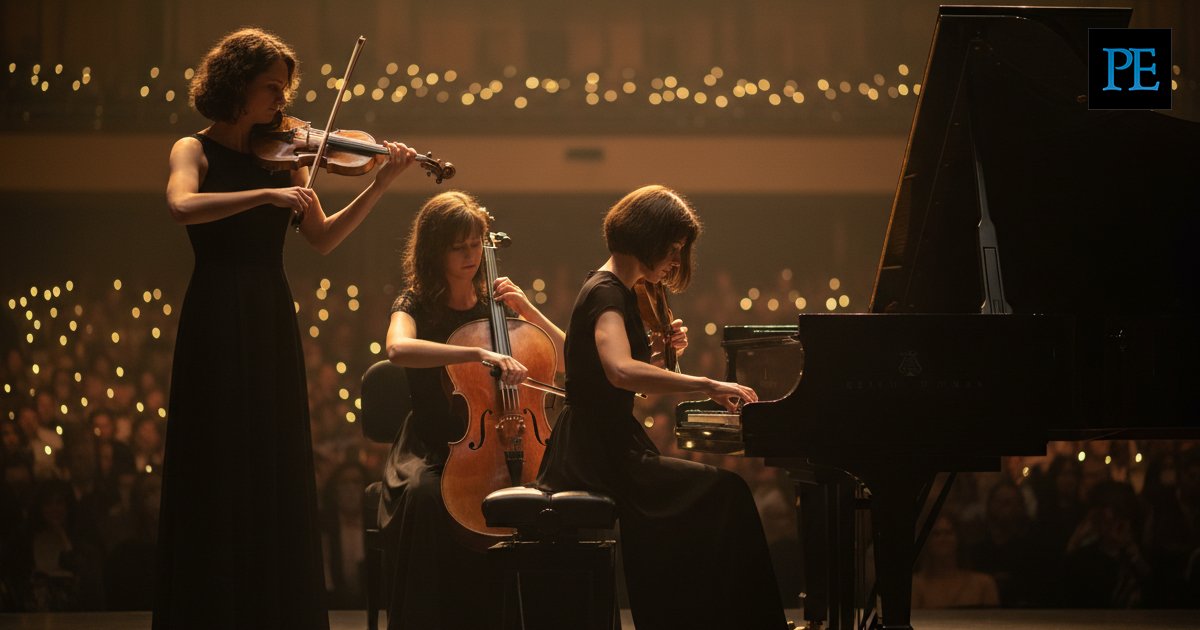
Commissioned by the Gryphon Piano Trio, and developed by them as a multimedia music theatre work which in addition to the members of the trio includes soprano Patricia O'Callaghan and Arabic singer Maryem Hassan Tollar, Constantinople is a collaborative work that speaks from the heart about cultural convergence. It is a metaphor for a utopian vision whereby the cultural and religious diversity of our world today – normally a cause for conflict – can become the seed of future peace and unrestrained creativity. This is of course a wonderful vision the particulars of which may boggle the mind but at the same time animate the heart. My own contribution to this larger issue of cultural convergence is to investigate it as a possibility within the frame- work of music and art.
Constantinople is a "un-place", a u-topos, where East and West, monophony and polyphony, improvisation and pre-compositional control, Islam and Christianity coexist peacefully, creatively challenging and complementing each other. It is important that such un-places become real in our own minds before they may become real in our lives. The music of Constantinople is imbued by this vision of convergence. While it acknowledges the dark aspects of cultural confrontation over the centuries and the tragedies that have been caused by narrow-minded cultural and religious allegiance, it stubbornly clings onto the positive effects of cultural and religious diversity and it is a celebration of the richness of this diversity, a spiritual inheritance to each and every one of us. In this sense Constantinople is less about the historical city that was founded by a Roman emperor, was the coveted capital of eastern Christianity and Hellenism for the better part of a millennium and the meeting place of East and West, and is now one of the great cities of the Islamic world. This work is more about modern day urbanism, where cultural diversity is a new - the only - emerging identity.
The music is in eight distinct movements which in their theatrical presentation follow one another without interruption. They are connected by improvised "bridges" which are not included in the present score. Creeds, the opening movement, starts with Christos Anesti, the Byzantine Easter chant of the resurrection sung in Greek by the mezzo-soprano, while the Middle-Eastern singer intones a similar creed from the Islamic faith. After several repetitions of these chants or improvised fragments, the cello inaugurates a long virtuosic instrumental section of the work that passes quickly from a variant of the previous Byzantine chant to a Balkan dance of Turkish origin, which in Greece is called chiftetelli, scored for the piano trio and an eclectic electronic soundscape.
The main melody for Kyrie, the following movement, is borrowed from an early work of mine by the same title, but it is presented here in a completely different light. First there are three separate settings of a long sequence consisting of 12 statements of the words "Kyrie Eleison" ("Lord Have Mercy Upon Us"), a standard orthodox ritual practice. These vocal utterances are accompanied first by string harmonics and ambient piano chords, followed by piano alone and finally by the violin and the cello creating contrapuntal lines that often emphasize the medieval character of the vocal melody. The third sequence is extended by an additional six 'Kyrie's before it abruptly gives way to the final 12 'Kyrie's. This latter setting is a radical departure from what precedes it. While maintaining a medieval feel to it, the predominant musical genre is pop with references to a number of various pop sub-genres. This is one of the most dramatic moments in of Constantinople, particularly at the moment when a full modern day battle is engaged in the surround sound system, which presages the more aggressive moments of On Death and Dying later in the work.
This tension is relieved by Odd World, the third movement, which is the first of three purely instrumental movements in Constantinople. Odd World takes its name from its rather eclectic musical content, but also because of its odd-numbered rhythmic and formal structure. The piece is in 5/8 and each phrase is seven measures long. Larger sections of the movement also reflect odd-number relationships. After a while these odd meters and phrases come to be expected as a matter of course so the music sounds much more symmetrical and consistent than one might expect given its numerical makeup.
Typically for a work that thrives on sharp contrasts, Odd World is followed by one of the gentlest sections in the entire work. Ah Kalleli is a Sufi song, a spiritual adoration of clouds, set for Maryem Hassan Tollar's voice and prerecorded and processed tracks of her voice delivered by the quadraphonic sound system. Again, the original Arab song soon visits areas that are very distant from its source. The instrumental interlude is based on one of the melodies of the Sufi song, but the stylistic palette encompasses as wide influences as jazz, early twentieth-century neoclassicism and blues while the return of the vocal component explores Maryem's ability to easily move from Middle-Eastern traditions to North American ones.
Composed three years after the completion of the rest of the music, Dance of the Dictators is stylistically a complete departure from what one might associate with a title such as Constantinople. It is a tango similar to the second half of Old Photographs that follows a couple of movements later. It was included partly to balance Old Photographs – a stylistically 'odd' movement in the original version of the work - but also to bridge a semantic gap between Ah Kalleli and On Death and Dying, the place where originally was to be an intermission in the performance. Dance of the Dictators was inspired by my own memories of adolescence (during which members of the ruling junta would preach cultural nationalism and then dance tangos during their leisure time) and by the 'dancing' strategies used by Saddam Hussein and the George W. Bush administration in attempting to sway public opinion during the weeks preceding the 2003 war in Iraq.
On Death and Dying was composed during a trying period in my life as my father was in his last weeks of fighting a losing battle with cancer. He was a man of uncommon courage, and as I was contemplating his life and his influence on me the very old poem of The Death of Dighenis, a Byzantine frontier hero, came to my mind. In the poem Dighenis (which in Greek means 'one of dual parentage or herit- age' – in his case Greek and Arab) engages in a physical struggle with Death, and Death cheats in order to win while the Earth shudders at the thought of covering him. This medieval popular view of death and the dread of death is in sharp contrast to the opening chant of the resurrection ('Christ has conquered Death through death') but up until now has been resonating more with most of us than the wonderful metaphysical message of life after death proposed by the Easter chant. The Dighenis song, an original composed in the style of old Cretan folk music, is introduced by the alto as a passacaglia or a ground. She is gradually joined by the mezzo-soprano, the cello, the violin and the piano, in that order. At the climax of this passacaglia-like treatment, the digital audio introduces heavily processed fragments of the open- ing of the Dies Irae ('Day of Wrath') from Giusepi Verdi's Requiem, and the music on stage quickly shifts to an original setting of the Dies Irae text featuring frantic instrumental writing accompanied by sounds of modern warfare assaulting the audience from the speakers in front and behind. After the Dies Irae, the music returns to the Dighenis setting and introduces the first of the two 'virtual' performers in Constantinople, Greek singer Lambros Vassiliou on tape. Lambros' haunting voice initiates a new passacaglia, which, like in Kyrie, under- goes stylistic transformation with each repetition. It starts as a Cretan folk song, followed by a setting reminiscent of Renaissance counter- point, and finally in a full instrumental and vocal configuration it turns into nineteen-sixties pop music featuring an electric guitar-like solo for the violin. On Death and Dying marks the first time the two singers sing together. It is their dramatic (and tragic) confrontation before they can overcome the difference that divides them in Alleluia.
Old Photographs provides an antidote to the heartrending intensity of the previous movement. It is the last purely instrumental movement in Constantinople and, like Dance of the Dictators, is totally based on western musical idioms. It starts with an introspective theme for solo piano slightly reminiscent of Robert Schumann, which is gradually joined in by the violin and the cello and transforms slowly - 'morphs' is a better word – into a tango in the style of Astor Piazzola, a light- hearted moment in the work which also foreshadows the exuberant and celebratory finale.
Alleluia starts by revisiting the multitude of themes and musical genres that have appeared in isolation in the work so far, often combining two themes from different movements in counterpoint with one another. The main theme of Alleluia, which first appears in the piano, has an interesting story attached to it. It was offered spontaneously by Maria, my ten-year-old daughter, one day as we were driving to Ottawa. She was bored in the back of the car and started making up tunes to occupy herself during the ride. During the days preceding the trip I was wondering how to bring Constantinople to a conclusion. A work like this that had already included so much in it called for something unique to finish, and nothing that I had tried up to that time I had felt to be satisfactory. When Maria started making up this 'alleluia' melody, it struck me that a child's song – ≠that particular spontaneous song - was the fitting conclusion to this work. This melody appears in an unabashed manner every time the music raises a dilemma of some kind with regards to one's attitude towards the human condition. It provides a prompting from the heart each time the mind stumbles and stalls - and the mind stumbles a few times in the course of this movement. When for example 'Hristos Voskrese', the Serbian Easter chant sung by the English Chamber Choir (the second 'virtual' performer in Constantinople), gradually turns first into a tragic climax and later into a still moment of nowhere to go, the 'alleluia' theme intercepts the musical indecision by affirming humanity in the midst of human cruelty. When the music of Kyrie returns as a prayer for forgiveness, the 'Alleluia' theme takes over the quietness of the moment of prayer and leads it into the closing celebration of life and perseverance.
Hatzis's bracing multi-media work...demonstrates that new ground can still be broken when treating the East-meets-West theme, and with flair...Effective as the visual dimension of Constantinople was and without slighting the vocal contribution, which reached a frenzied peak with the insistent repetition of the "Alleluia", the opera is mostly striking for Hatzis's instrumental writing, both on its own and in tandem with the singers. Hatzis is especially inventive in expounding on musical ideas, partaking not just of traditional developmental techniques but also of the methods of jazz and even rock to heighten rhythmic drive, though without debasing his material. A lilting tango supplies captivating variety, and Hatzis gives the piece unity by deftly bringing back certain themes.
Composer Christos Hatzis' interdisciplinary music-theatre piece, Constantinople...was staggeringly beautiful. In short, Constantinople was a towering achievement that was a lavish assault on the senses, and, at its best, a monumental fusion of many arts, rendered by an amazing array of very talented artists...Nothing can take away from the glory of Hatzis' music.