
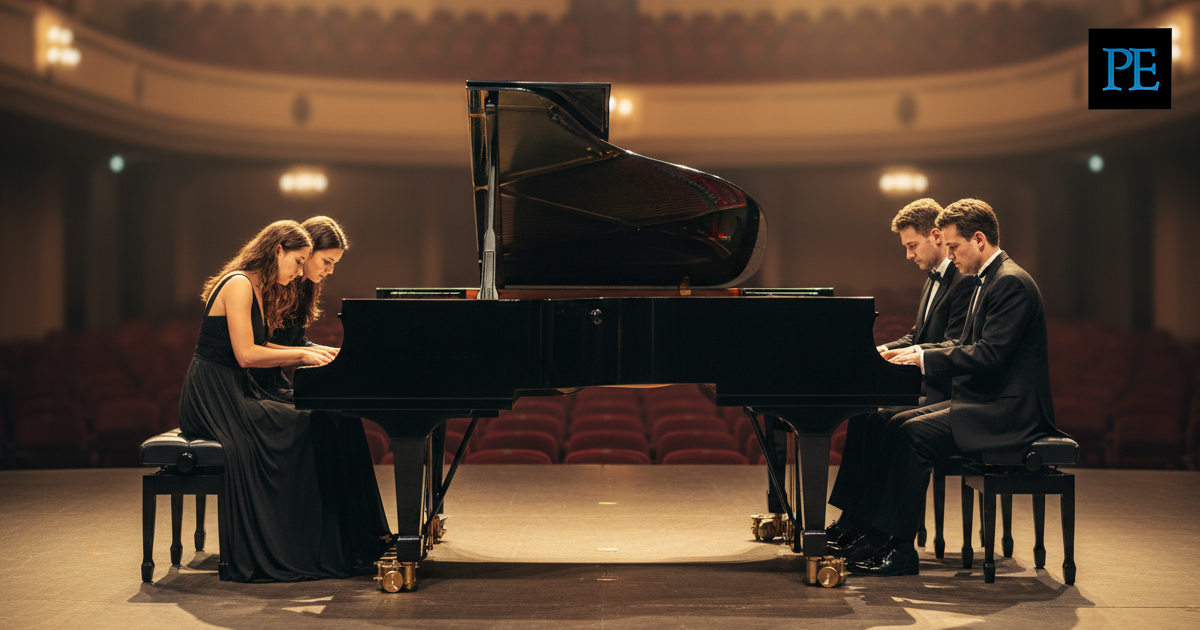
A Tedious Brief Scene: Bottom's Dance is a fine example of Holmes' work from her career as a composer and educator in New Zealand for over 25 years. Holmes was inspired to depict the character Bottom from Shakespeare's A Midsummer Night's Dream in writing this lighthearted work. It is highly engaging and energetic with elements of minimalist techniques of layered melodic ostinati, and jazz-influenced and non-tonal harmony.
Like the character and scene from Shakespeare's play, the music oscillates between moments of poignancy and boisterous self-confidence. It incorporates a variety of accented rhythmic patterns, changing metres and delicate melodic material, which gives pianists an opportunity to demonstrate their individual and combined talents as a chamber ensemble.
The title refers to a scene from Shakespeare's A Midsummer Night's Dream. The character Bottom, a weaver, is one of a group of rustic craftsmen who get together to rehearse a play for the Duke's court. As the butt of several jokes throughout the play he provides comic relief, but there is also an element of pathos to his plight, highlighting the themes of misperception and self-delusion woven throughout this lighthearted play. The music oscillates between moments of poignancy and boisterous self-confidence, and begins and ends with a bumbling, rustic dance.
One of the main rhythmic features is the contrasting "three against four" accent pattern. The four groups of three running semiquavers heard at the beginning transform into three groups of four with the entry of the stomping "waltz" bass line, and the piece continues to be disrupted with duplet/triplet combinations. In the middle section the rhythmic material begins to dissolve and more delicate motifs are introduced, along with a sequence of chords, which repeat with varying degrees of brashness, tenderness or poignancy, before the re-establishment of the rustic dance of the beginning, leading to a bumptious finale.
As this work was originally written for flute, oboe, clarinet, bassoon, horn, trombone, two percussion and piano, the challenge in transcription was to bring out the main themes in the piece without the contrasting timbral characteristics of the original group. However, the doubled bass and treble lines available with four performers on two pianos give sufficient scope to do this, and worked so successfully that it is now my preferred version of this piece.