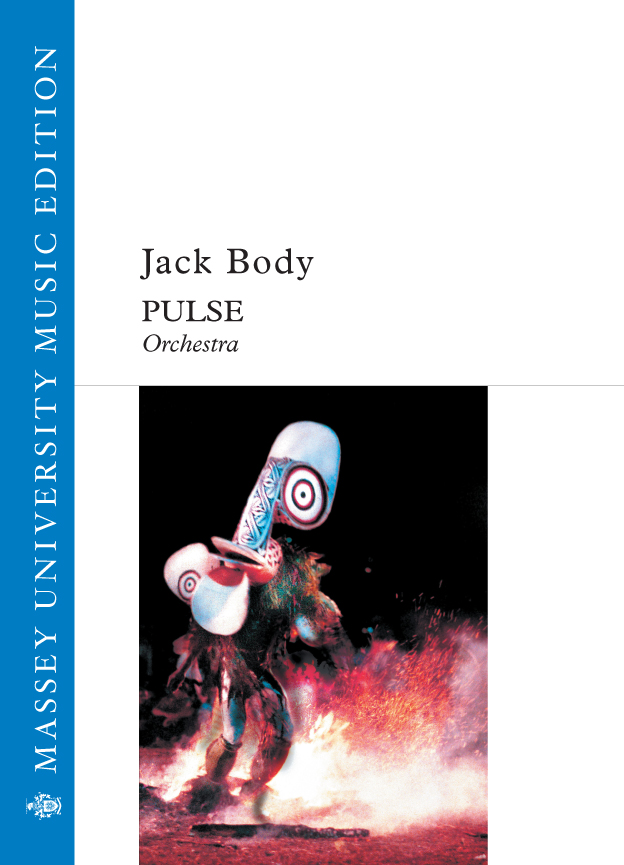
Central to Pulse is a transcription I made of the Fire Dance of the Baining people from East New Britain, Papua New Guinea, which I recorded in 1980 during a performance as part of the South Pacific Arts Festival. The spectacle of this dance was breathtaking: numerous dancers, with extraordinary, giant spirit masks – some of which reminded one of a praying mantis – stomped about, unscathed, in a fire. Their near-naked bodies glistened with oil, coloured in brilliant designs of white, black and red. It was only afterward, when I listened to the recording I had made, that I realised the music was equally as remarkable. A group of maybe a dozen men sang while pounding on a plank of wood with bamboo tubes. The regular pulses periodically broke into grouped patterns of whole beats. Simple enough, until I tried to decipher what these patterns were! They did not fall into any predictable duple or triple groupings but changed constantly. Likewise, the singing seemed not to be synchronised with the pulses in any simple way. The music, for all the apparent simplicity of its elements, had an astonishing complexity and richness which I have tried to unravel through my transcription.
Although Pulse is basically a "reconstitution" of the Baining Fire Dance, I have also made explicit references to composers whose music, I feel, explores in interesting ways the articulation of music pulse: Beethoven (the opening of the Eroica Symphony and the birdsong cadenza and storm episode from the "Pastoral" Symphony); Berlioz (from the first, third and fifth movements of the Symphonie Fantastique); and Stravinksy (from Le Sacre du printemps and the "double pas de quatre" from Agon). Each of these composers have a strongly corporeal feeling for pulse, an awareness that pulse is a fundamental life-force of music – just as the heartbeat is to living creatures – and that this pulsation is a dynamic thing, not metronomically regular but with an inner life and a susceptibility to change – sometimes sudden, sometimes gradual.
The quotation, transcription or reinterpretation of other music is something I have explored in many of my previous works – including the Carol to St Stephen (1975), Melodies for Orchestra (1983) and my electro-acoustic pieces using Indonesian soundscape material, although this is the first time I have tried to integrate Western music with (so-called) "ethnic" music.