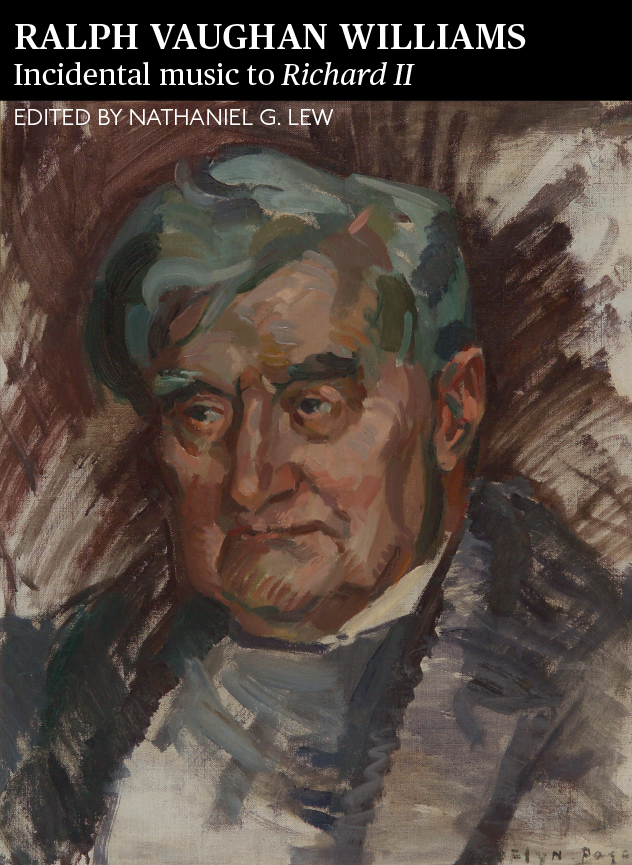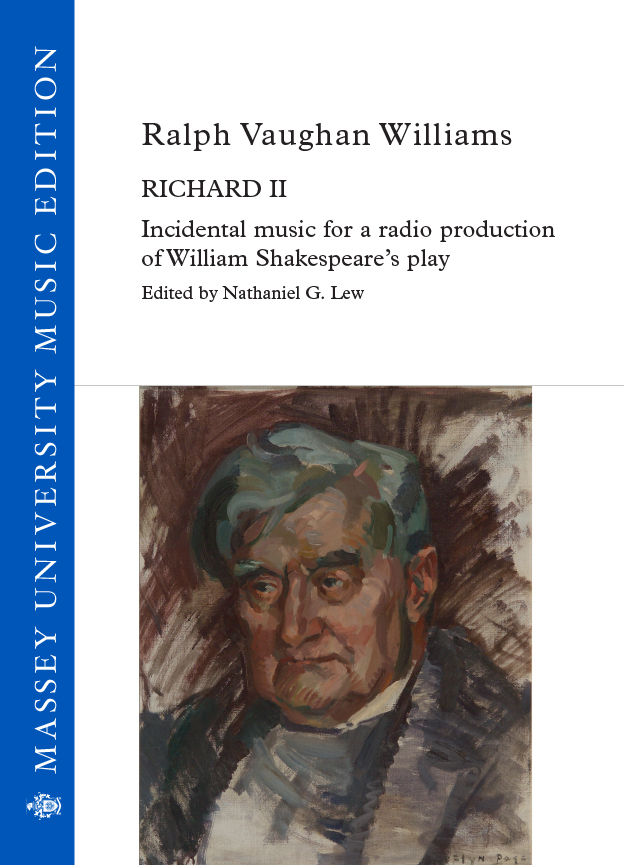
The present volume offers the first publication of Ralph Vaughan Williams's incidental music for a radio production of Shakespeare's Richard II. Although the composer prepared this extensive score, the production never materialized. Documentation of the project is scarce. Both Ursula Vaughan Williams and Michael Kennedy report that the BBC commissioned the score in 1944. Vaughan Williams himself refers to it as "paid for … but never used" in a 1951 letter to Hubert Foss. The piano sketch, short score, and full score now reside in the British Library (mss 71492, 63647, and 50432 respectively). Queries in the orchestral score in a copyist's hand suggest that instrumental parts were prepared, but neither these parts nor any recording has survived, nor has any other correspondence or documentation of the commission.
In this absence of records, one speculates whether the dark subject matter of the source text led to the project's cancellation. A play that depicts political dissension and regicide and advances a disquieting perspective on sovereignty seems an inapt subject for a period of intense military struggle and national uncertainty. But there is no reason that the BBC, even in 1944, should have vetted repertory solely on propagandistic grounds. In fact, the staff could reasonably have argued that broadcasting any of the Bard's works was inherently nationalistic.
Before the project's withdrawal, the BBC spent some time planning it. They clearly provided Vaughan Williams with a script edited for performance, since the spoken cues in the score reveal cuts at the end of scenes. In addition, the first half of Act I Scene 2 is interpolated after Richard's exit in the otherwise very long Act I Scene 2, to create three short scenes that alternate between the Queen and the rebels.
Vaughan Williams also gave the project considerable effort, composing approximately twenty-five minutes of original music scored for an orchestra with a full complement of brass and percussion. Setting aside the diegetic music - the trumpet fanfares and the "offstage" solo viola music Richard hears while imprisoned in Pomfret Castle - Vaughan Williams appears to have approached the project by composing themes for the major characters:
King Richard II has two themes: His main theme first occurs in m.7 in a sprightly D-major. This theme recurs frequently, but, as Richard's fortunes change, it turns to slower tempos, darker colours, and minor keys. The king's subsidiary theme consists of two linked four-note motives heard in numerous forms. At its slowest - marked "impending tragedy" in the piano sketch - this theme opens the score. It returns in this guise many times, notably transformed into a warm F major as Richard bids farewell to his queen (cue 28), and into a brief A-major apotheosis after Richard's death (cue 33). A livelier version of the same theme, first played in mm.15 - 19, indicates the King as often as does the main theme.
For Henry Bolingbroke, Vaughan Williams wrote a grinding chromatic phrase (cue 2) reminiscent of the music that characterizes Vaudeville villains, or the music for Satan in Job. On the basis of these themes, the composer's sympathies apparently sided strongly with Richard.
Inspired no doubt by the "Scepter'd Isle" speech, Vaughan Williams gave John of Gaunt music in his "visionary English" D-major mode, similar to many passages in The Pilgrim's Progress and the finale of Flos Campi. Introduced in m.23, this music dips into the minor mode before Gaunt's death.
The Queen has a short melody of her own, first heard in the oboe in cue 14.
Several other themes set a mood or location, rather than refer to individual characters. Thus, cues 3 and 4 bookend John of Gaunt's conversation with the Duchess of Lancaster, and the creeping bass lines of cues 15 and 16 surround the rebels' first meeting.
Most of the musical cues bridge scenes by shifting from the theme of the previous scene's dominant character to the theme of the character about to enter. Occasionally, the music begins under the final speech, and the length of some linking passages suggests that Vaughan Williams (or the producer) intended them to continue under the opening lines of the next scene. Beyond these overlaps, underscoring in most scenes is limited, but Vaughan Williams adopted a more cinematic approach than the BBC's usual procedures of the period, providing increasing underscoring as the play progresses. An ominous passage (cue 17) plays throughout Act II Scene 3, the scene of Bolingbroke's return to the "Wilds of Gloucestershire." (This music unaccountably returns in cue 30 as Exton steals into Pomfret Castle to murder Richard, where the "conspirator" music of cue 15 might be more appropriate.) Vaughan Williams similarly underscored Act II Scene 4, the dissolution of Richard's forces (cue 18). This stretch of music at the turning point of the play serves as a sort of Entr'acte. Act III Scene 3, the scene of the parley and Richard's surrender at Flint castle, also contains substantial underscoring (cues 21 & 22), as the retinue move from tower to ground. And Richard's farewell to his queen (cue 28) receives a full romantic background, which continues after the end of the scene in a musical commentary on the action.
Preparing this score for publication presented few problems. Allowing for the composer's typically sloppy hand, the manuscript is admirably clear. The task was to correct obvious slips of the pen, standardize dynamic and articulation marks, and update the notation to contemporary standards. I have also regularized Vaughan Williams's haphazard numbering of the cues and added the composer's penciled-in expressive descriptors to the tempo markings. Finally, in the Table of Cues, I have included the cues from Shakespeare's text that are marked in the orchestral score, checking them against the piano score and coordinating them with the standard published act and scene numbers.
—Nathaniel G. Lew, Editor