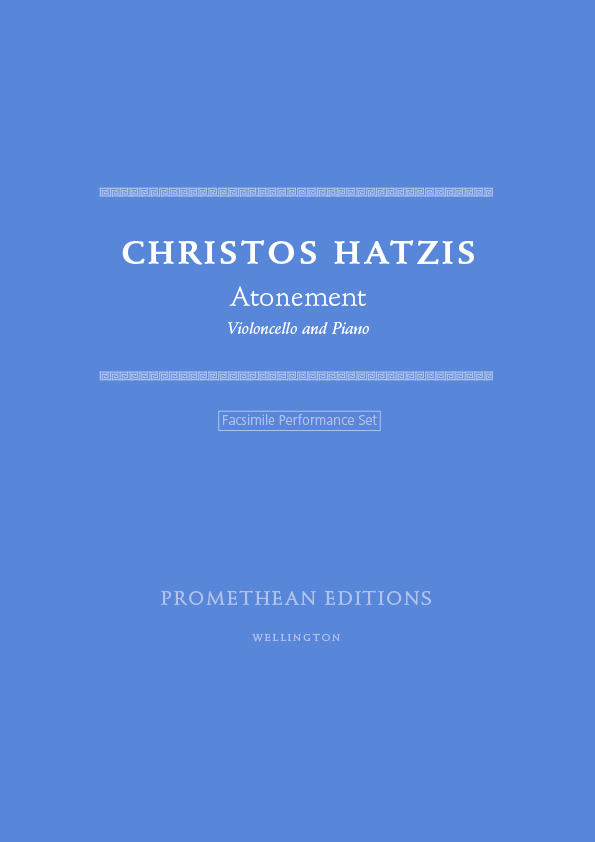
Atonement was commissioned by the Women's Musical Club of Toronto for cellist Yegor Dyachkov and pianist Jean Saulnier. The work owes its title to the fact that its composition began on the eve of Yom Kippur 2012, the Jewish Day of Atonement. The music opens with aggressive gestures and extreme dynamic fluctuations over the low cello C-string and its "overtone" chord, punctuated by syncopated stabs on the low piano. From this obsessive, asymmetrical backdrop two themes emerge, first a Jewish-sounding theme (which is likewise built loosely on the overtone series) and later a "gentile", tango-like theme. The first theme evolves significantly over time and, in the course of its evolution, it coaxes the music to ever-deepening moments of introspection marked by quiet cello melodies in artificial harmonics. By contrast, the exuberant ("gentile") second theme does not evolve at all, except for a fleeting moment of reckoning towards the end, and it is not instrumental in the process of Atonement, at least not to the extent that the first theme is. Appropriately, the music ends with variants of the first theme, which is ultimately the only theme that has left a strong imprint on the music.
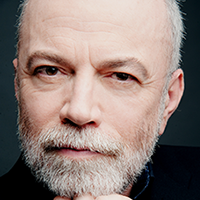
Born in Greece, educated in the United States and a Canadian citizen since 1985, composer Christos Hatzis (b.1953) is becoming widely known as a leading figure in contemporary classical music. His works are performed and broadcast throughout the world, and their frequent combination of a powerful spiritual foundation with an immediately accessible appeal has made a deep emotional impact upon audiences and performers alike.