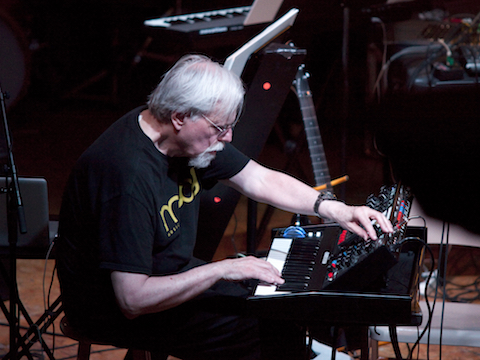
David Borden is a pioneer in the field of electroacoustic music. In 1969, with the support of Robert Moog, Borden founded the first synthesizer ensemble, Mother Mallard’s Portable Masterpiece Company, with which he performed his own works as well as music by Robert Ashley, John Cage, Terry Riley, Philip Glass, Steve Reich and others. The art of counterpoint has dominated Borden’s work, and his twelve-part cycle of works for synthesizers, acoustic instruments and voice, The Continuing Story of Counterpoint (1976–1987), has been called “the Goldberg Variations of minimalism.”
David Borden is a pioneer in the field of electroacoustic music. Borden perceives an almost spiritual dimension in the great works of contrapuntal writing, but found his efforts to unlock the secrets of their success were insufficient when studying advanced counterpoint theory—it never offered an answer as to why great contrapuntal writing affected him so deeply. For this reason he believes music theory is actually description rather than theory—one cannot predict whether a work will become more than the sum of its parts based purely on its adherence to the rules of counterpoint. “They (music conservatories) expect that you’ll know how the music works once you study the details of various structures and forms, but I’ve come to the conclusion that no one knows what makes music work. You have to study and learn as much as you can and then follow your own instincts.”
As a child, Borden was drawn to music that was comprised of multiple lines as opposed to melody-with-accompaniment. Borden’s father sought out music lessons for his son, and in the process it was revealed that Borden possessed perfect pitch—the gift that fuelled his interest in counterpoint. Curiously, Borden’s natural tendency to focus purely on individual notes inhibits his ability to identify functional harmony. “When I took harmonic dictation at Eastman the teacher would play a Bach chorale four times and we had to write it down. I would just write the soprano line first, the alto line second, the tenor line third, and then I would figure out the functions intellectually. It has made it very difficult for me to do jam sessions!”
The art of counterpoint has dominated Borden’s work ever since, with the composer acknowledging his Harvard teacher Leon Kirchner for encouraging him in following his own stylistic direction. “He was very influential in a strange kind of way. He wasn’t that methodical or formulaic but he drew you out to find your own voice and that was very important.” Borden also cites his experience of being composer-pianist for dance at Cornell University as a major influence on his approach to music. Upon taking up the position in 1968, Borden observed that while they were usually unfamiliar with its technical aspects, dancers were open to working with any type of music, no matter how strange. The receptiveness of the dancers in turn opened up Borden’s mind to his own music. He came to enjoy the work of composers such as Robert Ashley and became acquainted with John Cage through his accompaniment work with Cage’s partner, the dancer and choreographer Merce Cunningham.
As a teenager, Borden sought out composition lessons from jazz composer and arranger Jimmy Giuffre, of whom he was a fan. He also received lessons from jazz composer and arranger Jaki Byard. Borden studied at New York’s Eastman School of Music under Bernard Rogers and Howard Hanson. While at Eastman, he studied the music of Bach, Haydn and Stravinsky. He then undertook graduate studies at Harvard University under Leon Kirchner and Randall Thompson, and also studied at the Hochschule für Musik in Berlin on a Fulbright scholarship.
In 1969, with the support of Robert Moog, Borden founded the first synthesizer ensemble, Mother Mallard’s Portable Masterpiece Company, with which he performed his own works as well as music by Robert Ashley, John Cage, Terry Riley, Philip Glass, Steve Reich and others. In 1970 Mother Mallard’s Portable Masterpiece Company began recording their self-titled debut album, which was released in 1973. Borden maintained an interest in the development of digital synthesizer technology, incorporating it into his music along with a range of acoustic woodwind instruments and voices. The group released a total of 13 albums, with their last album, Waterwheel, arriving in 2005. Much of Borden’s output is for keyboard-based ensemble, and as well as concert works he has composed music for dance and film, including part of the soundtrack for the 1973 horror film The Exorcist. His twelve-part cycle of works for synthesizers, acoustic instruments and voice, The Continuing Story of Counterpoint (1976–1987), has been called “the Goldberg Variations of minimalism.”
In 1988 he founded the Digital Music Program (now the Cornell Electroacoustic Music Center), where among his specialty courses were MIDI techniques, counterpoint combined with electronic sequencing, and collaborative music composition using digital instruments. He retired as senior lecturer in 2005.
Recordings of Borden’s music are available on the Cuneiform, New World Records, Lameduck and Arbiter labels.