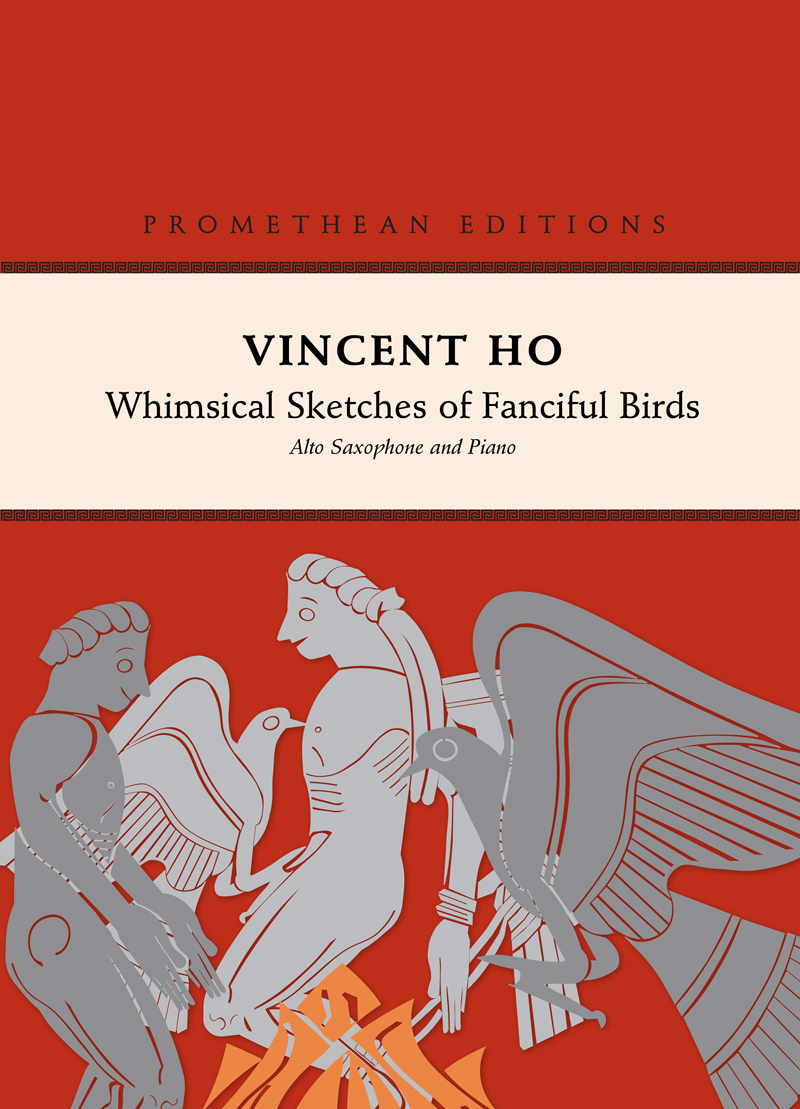

Vincent Ho’s Whimsical Sketches of Fanciful Birds transforms his childhood fascination with birds into vivid musical caricatures, combining playful storytelling with the saxophone’s expressive possibilities.
Book 1 for alto saxophone and piano, introduces five contrasting personalities, from “Inebriated Crows” and “The Watchful Owl” to the explosive “Short-Tempered Parakeet”, using glissandi, pitch bends, rhythmic instability and piano clusters to suggest movement, calls and temperament.
Book 2 extends this imaginative world through “Stoned Vultures”, “Mobster Magpie”, “Baby Phoenix”, “Sedated Seagull” and “Paranoid Hummingbird”, giving each bird recognisably human characteristics while exploring further possibilities of saxophone technique.
Book 3 retains the same instrumentation but broadens the cast with “Caffeinated Robyn”, “Corporate Puffin”, “Charming Goldfinch”, “Love Birds” and “The Angel and the Mockingbird”, continuing Ho’s affectionate, cartoon-like approach to musical characterisation.
Book 4, written for the Proteus Saxophone Quartet, shifts attention from individual personalities to collective identities, depicting a murder of crows, a murmuration of starlings, a charm of goldfinches, a parliament of owls and an ostentation of peacocks, extending the series’ imaginative premise into ensemble writing through five avian group portraits inspired directly by these evocative collective nouns.
The opening movement, Inebriated Crows, has the saxophonist and pianist negotiating rolling contours, with conflicting rhythmic subdivisions adding to the movement's disorienting quality. As the movement lurches toward its climax, the improvisation-like saxophone part incorporates glissandi to produce squawk-like calls, while the piano plunges with increasing frequency into its lower register.
In contrast to Inebriated Crows, the gently restrained Curious Swallow creates an unbroken air of mystery. The pianist conjures a backdrop of quiet suspense with a light andantino crotchet pulse sprinkled with delicate decorative droplets, while the saxophonist's statements evolve from initially tentative fragments into longer, more sensuous and expressive passages.
The short third movement, The Watchful Owl, is underpinned by the piano's soft, irregular pulse, while the saxophone emerges and subsides with controlled, sustained pitches. Both instruments climb incrementally towards their upper registers, working with the movement's tightening harmonic tension to heighten the state of muted suspense.
Waking Swan stirs into life with the piano's foundation of mid register triplet notes swelling to create colourful waves of harmonic clusters. Meanwhile, the saxophonist is drawn into increasingly adventurous technical material, incorporating pitch bends and honks in its onomatopoeic and increasingly abrasive depiction of the swan's physicality. The movement's growing waves of intensity culminate in the pianist's wingspan spreading to perform clusters at opposite ends of the keyboard, with the saxophone soaring about its upper register with tightly controlled glissandi.
Continuing the intensity of Waking Swan's climax, the frenetic Short-Tempered Parakeet is powered by the piano's relentless rhythmic drive. Both instrument lines move in wave-like yet somewhat jagged contours, and eventually combine at a frenzied peak in their respective upper registers. The movement continues to terminus with the saxophone's maniacal chatter being punctuated with fist clusters from the piano.
When I was a child, birds fascinated me and I spent a great deal of time learning about their many varieties. For each species I learned about, I would create imaginary cartoon-like characters based on them and dream up little stories to amuse myself. Whimsical Sketches of Fanciful Birds is my recreation of some of those childhood fancies in musical form.